COURT HEARING RECORD · DAY 4
Original record: Prison WatchEdited reconstruction by CPAA
Fourth Trial Hearing
悲劇不忘
KaiKai case citizen-judge trial | Monday, 28 April 2025
CPAA EDITORIAL INTRODUCTION
That day, the court asked not only what each person saw, but what they did after seeing it.

This page discusses alleged child maltreatment, bodily injuries, restraint, possible concealment and distressing messages. Testimony, prompted records and questions are not final judicial findings. This is an edited procedural reconstruction, not a verbatim transcript.
01 · OVERVIEW
Hearing at a glance
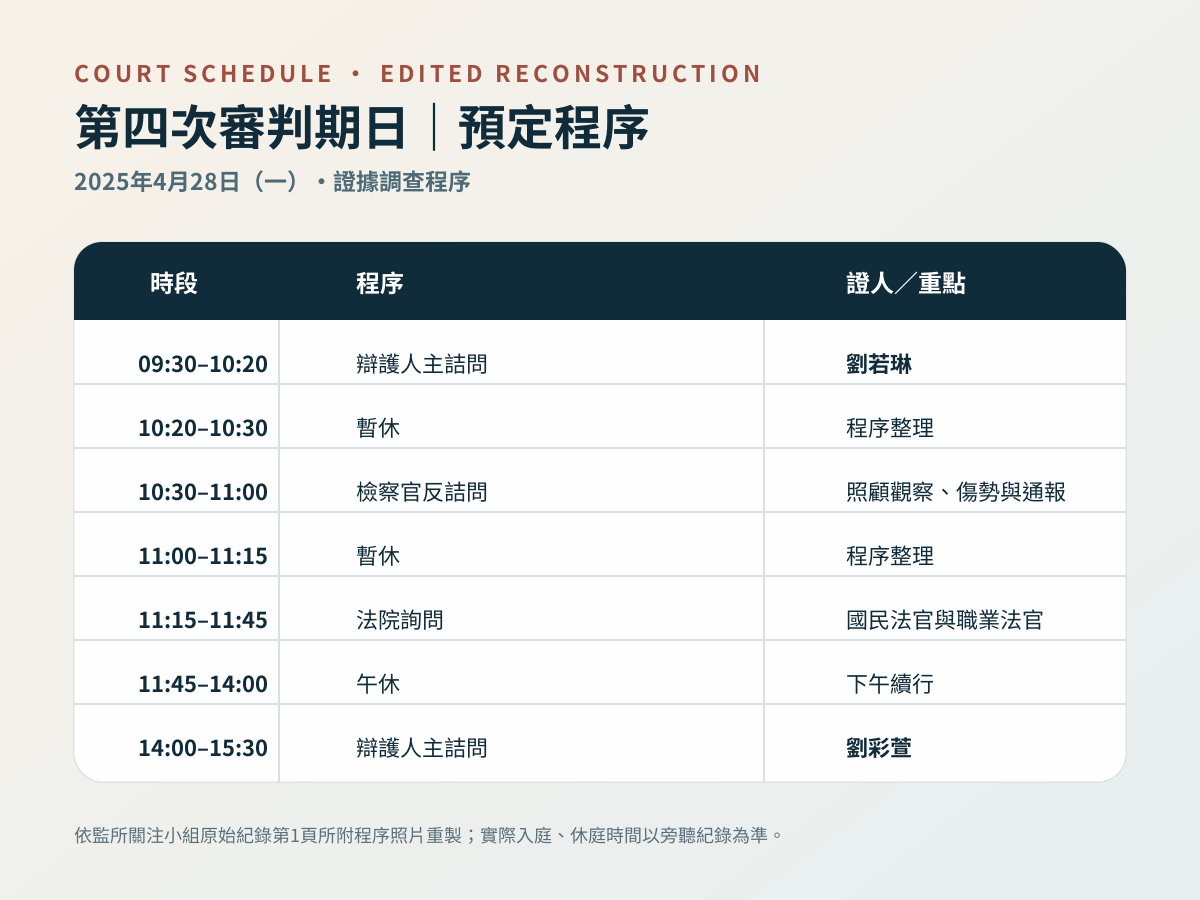
Proceedings resumed at 09:27. The court first identified a photograph and Wenshan weather-station data. Liu Ruo-lin testified in the morning and Liu Tsai-hsuan in the afternoon. The hearing examined three childcare locations, division of care, restraint and a basin incident, masks, a calm-down/standing area, injury reporting, photographs and communications. Court adjourned at 17:28.
02 · TWO WITNESSES
Two witnesses | Different accounts of the same care environment
The witnesses were sisters and licensed caregivers within the same childcare network. The page separates what was seen, asked, stopped, documented and reported.
01Morning
Liu Ruo-lin | caregiver and sister
Described head-banging, tooth grinding, injuries, nudity, standing, the basin incident, social-worker contact, photographs and messages.
Limit | She frequently said she forgot or had no impression; some points were reports or record-prompted recollections.Read notes02Afternoon
Liu Tsai-hsuan | defendant testifying as a witness
Described the three-location route and reasons offered for standing, restraint, the basin, an adult mask and injury reporting.
Limit | She framed several practices as protection, allergy management or cleaning; credibility remains for the court.Read notes03 · EVIDENCE LENS
Four lenses for reading Day 4
Locations, professional responsibility, physical records and changes in testimony must be read together.
Who was where
Keys, shared spaces and actual presence test the claim that each caregiver acted independently.
What happened after observation
Asking, stopping, untying, documenting, seeking care and reporting are separate steps.
Photos, audio and messages
Records test timing and memory but cannot be detached from context and authentication.
Ordinary injury procedure
The court compared what licensed caregivers said they normally did with what was done here.
Night-time sleep, some photographs and standing episodes.
Near-daily visits and the basin incident.
Meals, the calm-down area and basement entrance.
04 · TIMELINE
Day 4 timeline
Court-initiated exhibits
Photograph and Wenshan temperature data.
Liu Ruo-lin
Direct, cross and judges’ questions.
Midday break
Liu Tsai-hsuan began after court resumed.
Liu Tsai-hsuan
Daily route, restraint, standing, reporting and records.
Adjournment
Final questions on photo times and the claimed onset of head-banging.
05 · EXAMINATION
How examination tested the accounts
These are lines of inquiry, not findings adopted by this page.
What a fellow caregiver did after seeing warning signs
Questions separated noticing, asking, stopping, documenting and reporting.
Head-banging, allergy, cleaning and protection
The defence and witnesses offered reasons for restraints, masks, bathroom feeding and leg elevation.
Testing “I told the social worker”
Oral reminders, missing message traces and the claimed concealment of a neck injury were compared.
Photos, messages and prior statements
Prompts tested repeated “I forgot” answers while leaving context and weight to the court.
06 · JUDGES’ QUESTIONS
Eight recurring questions
The judges repeatedly returned to professional practice and concrete response.
What happened after the basin overturned?
Untying the child was distinguished from asking, documenting and reporting.
How would an injury to another child be reported?
Ordinary practice was compared with the response here.
Were restraint and bathroom feeding normal?
The witness said they were not used with other children.
What did outdoor temperature show about the room?
Weather context and actual indoor conditions were separated.
When did a calm-down area become standing punishment?
The name of a practice was compared with its duration and effect.
Why were towels, nets and bags used?
The asserted protective purpose was tested against the means.
Why hide an injury after being reminded to report?
Professional duty and the witness’s stated motive were placed side by side.
How do records interact with “I forgot”?
Messages and photographs can test memory but require full context.
07 · LIMITS
Reading limits
“Head-banging” is an account, not a diagnosis
No medical assessment is completed by the word itself.
“I do not remember” defines memory only
It proves neither occurrence nor non-occurrence.
Locations must remain consistent
Every episode requires its place, participants and basis of knowledge.
Messages require context
Timing, authentication, full threads and other evidence remain necessary.
08 · EVIDENCE & PROCEDURE
Evidence and procedural nodes
Photograph dated 23 September 2023
The court discussed provenance, timing, appearance and nutrition.
Wenshan weather-station data
The defence questioned whether outdoor data reflected indoor temperature.
Scope of cross-examination
An objection concerning a red container was sustained as beyond direct examination.
09 · EDITED COURT RECORD
Full edited notes by procedure
Repeated questions are consolidated and wording is shortened. This is not a verbatim transcript; consult the original Chinese record for the full text.
COURT RECORD · EDITED NOTES
Court-initiated exhibits
Photograph and weather-station data
Proceedings resumed at 09:27.
Presiding judge
The court first identified Exhibit 86, a photograph dated 23 September 2023, and Exhibit 87, daily temperature data from the Wenshan station for December 2023.
Prosecutor
Asked the court to note the photograph’s provenance, date, the child’s appearance and nutrition, and the detailed temperature fields.
Counsel for Liu Tsai-hsuan
Asked whether outdoor station data could properly reflect the indoor temperature.
COURT RECORD · EDITED NOTES
Liu Ruo-lin | direct examination
What she saw, heard and remembered
The court explained the privilege against self-incrimination and perjury liability; the witness was sworn.
Direct examination by counsel for Liu Tsai-hsuanLiu Ruo-lin answered
問
How often did the child come to your home?
Liu Ruo-lin
Occasionally, mainly in the afternoon and sometimes at night, when Liu Tsai-hsuan went out or moved between locations.
問
What drew your attention?
Liu Ruo-lin
She described episodes of head-banging, moaning, profanity, tooth grinding and picking at the hands, while repeatedly saying she could not recall dates or sequence.
問
Did you see injuries?
Liu Ruo-lin
She recalled bruising, a small mark between the eyebrows, scabs on a hand and swelling at the back of the head; she said falls were offered as explanations.
問
Did you tell her to report to the social worker?
Liu Ruo-lin
She said she did, orally, and was told a report had been made.
COURT RECORD · EDITED NOTES
Liu Ruo-lin | cross-examination
Nudity, standing, restraint and feeding in a bathroom
Break at 10:23; court resumed at 10:37.
Cross-examination by the prosecutorLiu Ruo-lin answered
問
Did you see the child naked or standing?
Liu Ruo-lin
She had seen the child naked and standing, but said she did not know whether this was punishment.
問
When the child hit his head, why were his hands and feet tied? Did you ask?
Liu Ruo-lin
She said she did not ask.
問
Why is the alleged oral reminder to the social worker absent from LINE messages?
Liu Ruo-lin
She said it was raised in person, at meals or when she remembered.
問
Was the child fed in a bathroom?
Liu Ruo-lin
She recalled Liu Tsai-hsuan saying an oral injury caused bleeding or vomiting and the bathroom was easier to clean.
Court
An objection was sustained when the prosecutor sought to show a red container beyond the scope of direct examination.
COURT RECORD · EDITED NOTES
Liu Ruo-lin | questions from judges
The basin incident and professional response
Break at 11:03; court resumed at 11:32.
問
What happened when the basin overturned?
Liu Ruo-lin
She said she ran from the kitchen, saw the child’s hands and feet tied, righted the basin, untied and carried the child to the living room.
問
Did you ask Liu Tsai-hsuan? Did this seem normal?
Liu Ruo-lin
She said she did not ask and did not think much of it at the time.
問
How would you handle an injury to a child in your own care?
Liu Ruo-lin
She would photograph it and notify the social worker by LINE, explaining the injury and cause.
問
Were other children tied, fed in a bathroom or known to hit their heads?
Liu Ruo-lin
She said no.
問
What did you understand from terms such as “dead kid” and a message about knocking him unconscious?
Liu Ruo-lin
She acknowledged inappropriate language and said she had seen Liu Tsai-hsuan pat or strike a body area, while her memory of the messages was limited.
COURT RECORD · EDITED NOTES
Liu Tsai-hsuan | direct examination
Three locations, the “calm-down area” and restraint
Break at 12:53; court resumed at 14:33.
The court explained the privilege against self-incrimination and perjury liability; the witness was sworn.
問
What was the daily route?
Liu Tsai-hsuan
She described moving from the sleeping location to Liu Ruo-lin’s home almost every morning, then to the main childcare location for lunch, and back to the sleeping location at night.
問
What was the “calm-down area”?
Liu Tsai-hsuan
She said the child stood there when crying; initially she returned after about ten minutes, later leaving him until he became quiet.
問
Did Liu Ruo-lin object?
Liu Tsai-hsuan
She recalled being told not to leave the child standing alone, but said she continued.
問
Why was the child tied in a basin on 2 November?
Liu Tsai-hsuan
She cited head-banging and concern for Liu Ruo-lin after surgery, and said she used a long towel before leaving temporarily.
問
Why nets, plastic bags or a chair?
Liu Tsai-hsuan
She framed the acts as protection and improvised restraint, calling the conduct foolish.
問
Why the adult mask?
Liu Tsai-hsuan
She cited persistent nasal discharge, allergy, cold air or dust mites.
問
Why were the legs raised?
Liu Tsai-hsuan
She said it was intended to reduce swelling for 15–20 minutes after lunch.
COURT RECORD · EDITED NOTES
Liu Tsai-hsuan | cross-examination
Shared care, punishment and record prompts
Break at 15:33; court resumed at 15:45.
問
Could you freely enter the main locations?
Liu Tsai-hsuan
Yes. She said childcare occurred mainly at one location by day and sleeping at another by night.
問
Were the four children truly cared for entirely separately?
Liu Tsai-hsuan
She maintained separate placements but acknowledged interaction and occasional help from Liu Ruo-lin.
問
Was the separation linked to income?
Liu Tsai-hsuan
She agreed that separate registrations allowed each caregiver to take two children and increase income.
問
Did the “calm-down area” become punishment?
Liu Tsai-hsuan
She eventually described it as a place for standing punishment and acknowledged standing punishment at the sleeping location too.
問
Did Liu Ruo-lin know?
Liu Tsai-hsuan
She first said no, then after a Facebook message was shown said she had forgotten because it was long ago.
問
How should violent-sounding chat messages be read?
Liu Tsai-hsuan
She characterised some of them as casual talk or nonsense.
COURT RECORD · EDITED NOTES
Questions from citizen and professional judges
Reporting and the claimed concealment of injury
Break at 16:37; court resumed at 16:50.
問
Did Liu Ruo-lin remind you to report injuries?
Liu Tsai-hsuan
Yes.
問
Why was the child made to sleep during a social-worker visit?
Liu Tsai-hsuan
She said she feared the neck injury would be discovered, criticism would follow, and future referrals might be affected.
問
Were later injuries reported?
Liu Tsai-hsuan
She said a head injury was reported.
問
Did Liu Ruo-lin stop you from scolding?
Liu Tsai-hsuan
Yes, but not from tying the child or placing him in the basin.
問
Why did the mask reach the eyes?
Liu Tsai-hsuan
She said it was not intentional and resulted from using an adult mask.
問
Did the child arrive with wounds?
Liu Tsai-hsuan
No.
COURT RECORD · EDITED NOTES
Chat records, photo times and adjournment
Final prompts by the presiding judge
Record summary
Messages included violent or demeaning phrasing. The witness described some exchanges as joking or nonsense; this page retains only the minimum needed to explain the court’s line of inquiry.
問
How did you explain the message about keeping the child awake?
Liu Tsai-hsuan
She said the child might hit his head when not sleeping, while also saying he was difficult to settle.
Presiding judge
The prosecutor was asked to show a slide listing photographs at 01:47 on 27 September, 01:41 on 1 October and 01:54 on 6 October.
問
Was the photographed person the child, and was this a sleeping position?
Liu Tsai-hsuan
Yes.
問
When did you first notice alleged head-banging?
Liu Tsai-hsuan
Early September, she said.
Court adjourned at 17:28.
17:28 · COURT ADJOURNED
Day 4, adjourned
CPAA EDITORIAL CLOSINGDay 4 could not be reduced to “I saw” or “I did not know.” Locations, photographs, messages, professional duties and subsequent action formed a chain that the court tested one link at a time.
Source
Read original record ↗Prison Watch
Original: DAY4 | Monday, 28 April 2025 — Fourth Trial Hearing
Edited, structured and animated by the Child Protection Action Alliance. Where questions arise, the original Chinese record and public court materials control.