COURT HEARING RECORD · DAY 3
Authorized by Prison WatchHighlights edited by CPAA
Third Trial Hearing
悲劇不忘
KaiKai case citizen-judge trial record | Friday, 25 April 2025
CPAA EDITORIAL INTRODUCTION
What was the child's life like before the harm? Across caregivers' memories, the court traced changes over time.

This page discusses alleged child maltreatment, bodily injuries, and distressing testimony. Witness statements and the parties' submissions are not the court's final findings.
01 · OVERVIEW
Today's hearing at a glance
Proceedings resumed at 09:23. Two former caregivers and Liu Tsai-hsuan's son testified about the child's earlier care, handover information, health and development, later observations in the household, and the limits of memory and direct observation. The court adjourned at 17:24.
02 · THREE WITNESSES
Three witnesses | What each said
Each witness had a different period of presence, relationship to the parties, and opportunity to observe. The cards separate the scope and reading limits of each account before linking to the full courtroom Q&A.
These cards are an editorial guide; the authorized source and the court's evidence inquiry remain controlling.
01Dates require checking
Chou | former caregiver
Described routine, food, health, development, bodily marks, and handover during a period of full-time care.
Reading limit | The source gives two sets of start and end dates. Medical points largely reflect memory and what she said she was not told.View testimony highlights02About 4–5 months old
Hsiao | former caregiver
Described tight limbs, crying, massage, medical advice, and reporting during a shorter period of full-time infant care.
Reading limit | The account covers a brief infancy period. Advice to observe or seek care is not itself a judicial finding of illness or caregiving difficulty.View testimony highlights032023.09–12
Wang | Liu Tsai-hsuan's son
Described interactions, a fall account, headgear, towel wrapping, crying, and household episodes while moving between home and work.
Reading limit | He said he did not provide care and was not necessarily present daily. Six source-check groups cover speech, headgear, the fall, locations, and the towel.03 · EVIDENCE LENS
Four lenses for reading Day 3
The testimony spans different ages and caregiving stages. “Yes” or “no” must be read together with time, scope, and how the witness knew.
Baseline and comparison
Former caregivers described food, walking, play, oral condition, and bodily marks during their own care periods.
What information was passed on
Questions tested meetings, social-worker contact, medical checks, reminders, and whether information reached the next caregiver directly.
Medical notes, photos, and messages
The parties used clinic records, blood results, photographs, floor plans, and messages to test memory.
Relationship, memory, and pending matters
Family ties, indirect knowledge, timing inconsistencies, and a separate investigation were raised as matters relevant to weight.
04 · HEARING TIMELINE
Day 3 hearing timeline
The source contains one apparent chronology conflict. The original wording is retained and flagged in the full record.
Chou testified
Care history, health, development, handover, and photographs of bodily marks.
Break and judges' questions
Language, walking, teeth, visitation requests, and marks.
Hsiao testified
Infant care, stiffness, crying, medical advice, and reporting.
Wang testified
Household movement, frequency of observation, the fall account, head protection, towel wrapping, and crying.
Break and judges' questions
Observation range, rooms, household interaction, and actual presence.
Rulings and adjournment
The court set out further evidence inquiries.
05 · EXAMINATION
How examination tested the accounts
These are lines of questioning and answers, not this page's endorsement of any party's position.
Building an earlier developmental baseline
Questions covered food, sleep, walking, play, emotion, teeth, oral condition, bodily marks, and care difficulty.
Testing memory and the basis for “normal”
Clinic visits, weight changes, blood results, respiratory symptoms, and what doctors said were put to the witnesses.
Separating direct sight, peripheral vision, and report
Work travel, return times, household contact, and the basis for the fall, headgear, towel, and crying accounts were examined.
Family relationship and separate investigation
As recorded in court on 25 April 2025, the prosecutor raised a separate perjury investigation to impeach credibility; the defense said it remained under investigation, with no indictment or trial. That procedural dispute is not a finding that this testimony was true or false.
Sensitive contentRead the categories discussed in testimony
The testimony addresses hand wounds, head redness, a fall account, towel wrapping, crying, excretion, and genital observations. This page does not reproduce injury photographs or reenact alleged harm.
“Did not see an injury” refers only to the witness's care period or field of observation and does not prove that no injury existed at another time.
06 · CITIZEN & PROFESSIONAL JUDGES
Citizen and professional judges | Key questions
Eight editorial themes summarize questions on handover, development, oral and bodily condition, visitation, infant stiffness, the fall and headgear, towel wrapping, and limits of knowledge.
These themes are CPAA's reading guide, not an exhaustive list.
Start with three groups: 4 / 1 / 3
Select a witness to move to the first question in that group.
The counts are editorial reading themes, not measures of court acceptance or evidential weight.
- A judge asked≠The court accepted it
- Not known / not seen≠It did not occur
- Closing submission≠Reasons for judgment
QUESTION PATH01 / 08
Chou
What was actually said at handover
Chou said she asked the next caregiver to love, hold, and comfort the child, while feeding details were given to the social worker.
Why it matters | Who held the information, through whom it passed, and whether it reached the next caregiver directly.View full Q&AChou
Language, walking, and daily abilities
Chou described reduplicated words, calling her “grandma,” stable walking, block stacking, page turning, and getting his own cup.
Why it matters | Establishes functioning during a specific earlier care period.View full Q&AChou
Teeth, mouth, and bodily marks
Chou said the teeth were firm and the mouth intact and that hand spots and a brown arm mark were not present during her care.
Why it matters | Comparison still requires reliable photo dates and conditions.View full Q&AChou
Why a visitation request did not proceed
Chou said she asked to visit but was refused and later heard nothing further.
Why it matters | This is her account; policy, decision-maker, and complete records require separate verification.View full Q&AHsiao
Did infant stiffness make care difficult?
Hsiao said she massaged the child's tight limbs but found no special caregiving difficulty or developmental difference.
Why it matters | Separates a recommendation to observe or seek care from everyday caregiving difficulty.View full Q&AWang
Fall, ointment, and protective headgear
Wang described a fall seen in peripheral vision, later ointment, and searches for headgear; the ordered and gifted items were not identical.
Why it matters | Separates events, reported explanations, and objects from different times.View full Q&AWang
Towel wrapping and room layout
Wang described seeing the child wrapped in a towel on a computer-room mat, while also saying family members rarely talked and he often went straight to his room.
Why it matters | Tests both specific observations and ordinary access to household life.View full Q&AWang
What the witness did not know
Wang did not know the child's routine, food and water intake, subsidy details, or dental condition at first meeting.
Why it matters | Not knowing is not proof that something did not occur.View full Q&A07 · TESTIMONY LIMITS
Four reading cautions
Six source-check groups
The PDF's language entries show an apparent tension
Record A | At the first meeting, the child allegedly said a complete five-character profanity, slowly.
Record B | Wang later said the tone was unclear but recognizable; the PDF's final passage separately says that he had not heard the child speak, but no corresponding question is shown.
Clarify | The last line may be omitted, misplaced, or missing wording such as “other.” It should not be treated as a direct contradiction without the hearing audio or official transcript.
When the headgear was ordered, and whether he saw it
Record A | After a late-November or early-December fall, Wang said his mother asked him to order headgear and that he saw a blue item in the computer room.
Record B | He separately dated the order to September or October; on cross-examination the PDF says he had not seen the headgear.
Clarify | Were there two events? Did “not seen” mean the object itself, or not seen worn by the child?
The same injury passage pairs a home observation with a park report
Record A | Wang said he saw a figure fall at home in peripheral vision while putting on his shoes, after which his mother obtained an ice pack.
Record B | Later that evening, while applying ointment, his mother reportedly said the child had fallen in the park.
Clarify | Whether these refer to the same fall, and which event the ointment and headgear relate to, still requires checking.
The B and C location labels do not match
Record A | The source first defines Location B as No. 6, 3F, and Location C as No. 4, 3F.
Record B | The fall passage later says “returned to No. 6, 3F (Location C).”
Clarify | This may be a source typo or confusion in the account; it should not be silently corrected without the official transcript.
Lighting and movement in the towel account need completion
Record A | At about 2 a.m., Wang said he did not turn on the light to avoid waking his father and compared the towel's color with a prompted photograph.
Record B | The source lists wiping in the bathroom, wrapping in the computer room, standing, and being on a mat without clearly setting out the sequence; he also referred to a planned headgear purchase when explaining why the towel did not seem unusual.
Clarify | The available light for color recognition, sequence of movement, and connection between headgear and towel wrapping require checking.
Multiple episodes within limited contact require individual checks
Record A | Wang said work was busy, he did not see the child every day, did not provide care, rarely chatted with family, and usually went straight to his room.
Record B | He also described profanity, a scab, fall and first aid, towel wrapping, grinding teeth, crying, and headgear, while not knowing the routine, sleeping room, or food and water intake.
Clarify | This is not necessarily a contradiction. Each episode needs dates, viewing conditions, and corroboration and cannot be extrapolated into the whole daily-care picture.
Time periods
The former caregivers spoke about earlier periods; Wang described scattered observations from September to December 2023.
Modes of observation
Direct sight, peripheral vision, sound, family report, and documentary prompts rest on different foundations.
Memory and source conflict
Witnesses repeatedly said they did not remember. The source also contains a chronology conflict and incomplete wording.
Submissions are not findings
Prosecution, defense, and participating counsel summaries remain party positions for the court to assess.
08 · COURT RULINGS
Four rulings and further inquiries
According to the source record, the presiding judge stated the following before adjournment.
Challenge to expert rejected
The court found Dr. Chiu Yen-nan professionally qualified and said the presentation did not establish collusion.
Temperature data
The court ordered daily December 2023 temperatures from the Wenshan monitoring station.
Photo and court-contact record
The court ordered inquiry into one photo provided by Chou that day and the court's contact record.
Parties to comment next hearing
The parties would comment on the court-ordered inquiries before Liu Jo-lin's examination on 28 April.
FULL AUTHORIZED TRANSCRIPT · DIALOGUE EDITION
Complete Day 3 observation dialogue
The record is reorganized by procedure and speaker rather than PDF page. Adjacent text in the same question group is rejoined by meaning; browser headers, URLs, page numbers, and print timestamps are omitted. Ambiguities in the original are noted rather than filled in.
Yellow: key text in the PDFPink cards: editorial issue notesNotes aid reading and are not final court findings.
Cited file: DAY3 ▌2025年4月25日(五)第三次審判期日.pdf|Provided by: 監所關注小組|View original publication
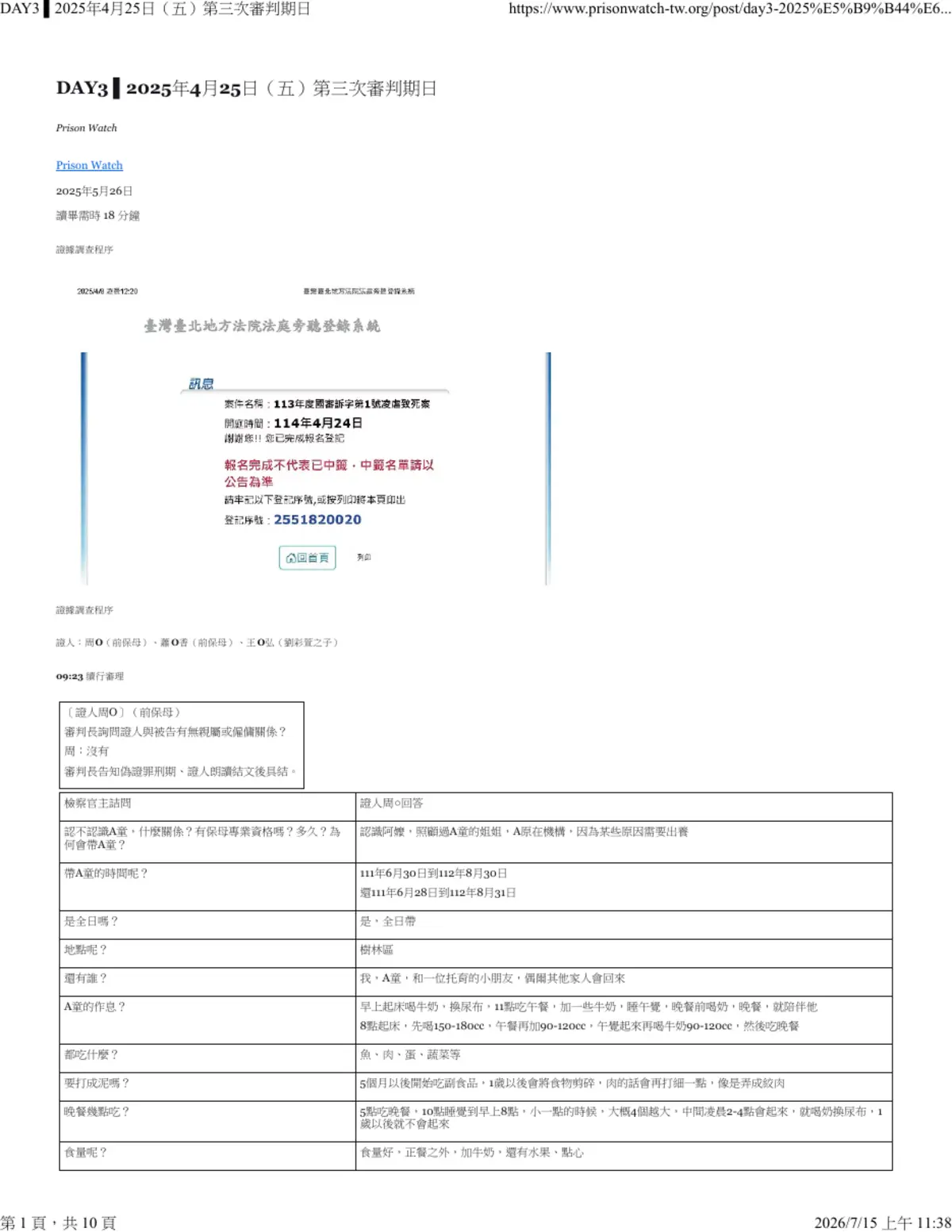
The complete authorized record below remains in the original Chinese. The English interface and summaries are CPAA translations; for testimony, refer to the source PDF.
COURT RECORD
續行審理與周○具結
09:23 · 證據調查程序
09:23 續行審理
審判長
詢問證人與被告有無親屬或僱傭關係。
周○
沒有。
審判長告知偽證罪刑期,證人朗讀結文後具結。
COURT RECORD
周○|檢察官主詰問
照顧期間、日常生活與外傷觀察
檢察官主詰問證人周○回答
問
認不認識A童?有保母專業資格嗎?為何會照顧A童?
周○
認識阿嬤,照顧過A童的姐姐。A童原在機構,因為某些原因需要出養。
問
照顧時間?是否全日托?
周○
先答111年6月30日至112年8月30日,又答111年6月28日至112年8月31日;是全日照顧。
問
地點、同住者與作息?
周○
在樹林區。我、A童和一名托育幼兒,家人偶爾回來。約8點起床喝奶、換尿布,11點吃午餐並補奶、睡午覺,下午再喝奶,5點吃晚餐,10點睡到翌日8點。
問
吃什麼?需要打成泥嗎?食量如何?
周○
魚、肉、蛋、蔬菜。五個月後開始副食品,一歲後剪碎,肉再打細如絞肉。食量好,正餐外還有牛奶、水果與點心。
問
睡眠與健康狀況?
周○
睡眠都還好;健康很好、按時接種。因轉往其他寄養家庭,兒福聯盟要求到亞東醫院健檢,回去看報告時沒有被告知異常。
問
個性、情緒與相處?
周○
一歲後會走路,有時調皮,個性溫和,見陌生人會害怕,情緒算穩定。感情很好,會抱抱、多陪伴,玩字卡、球與玩具。
問
愛哭、罵髒話、倒地僵直、自傷或需要特別費心嗎?
周○
不愛哭,幼時想喝奶會哭;不會罵髒話,也未接觸會罵髒話的人;不會倒地全身僵直、不會自傷,沒有特別難照顧。
問
接手時有哪些提醒?適應多久?
周○
兒福聯盟給了一張提醒事項;換尿布時較僵硬,到新環境會害怕,約一個月適應。
問
前保母交接時及你照顧期間有外傷嗎?
周○
沒有。並表示到劉彩萱家的照片中,A童和其他孩子一起玩時表情不同。
劉彩萱辯護人異議;審判長裁定駁回,認照片陳述非臆測。
COURT RECORD
周○|反詰問與覆主詰問
就醫、體重、交接與照顧細節
劉彩萱辯護人反詰問證人周○回答
問
全日托包含週末?照顧期間接觸過母親嗎?
周○
包含週末。照顧A童期間未接觸母親,先前照顧過姐姐。
問
是否曾因生病就醫?紀錄顯示2023年5月至8月多次看診。
周○
換季溫差大會流鼻水,會帶去小兒科;日期已不記得,有紀錄就有。醫師說鼻子較過敏。
檢察官對提問異議;法官詢問辯護人提問目的,裁定異議成立。
問
交給劉彩萱時大約多重?
周○
大約10公斤,有體檢,寶寶手冊記載10.6公斤;只記得十點多到十一公斤。
問
提示亞東醫院及血液檢查紀錄,體重約10.8公斤、肌酐酸過低,醫師有說明嗎?
周○
沒有印象、不記得;領報告時若異常醫師會說明,當時記得醫師說正常。
問
交接情形?
周○
原要求兩次互動,她去過一次;另一次無法請假,由外婆與社工前往。曾向兒福聯盟詢問能否取得A童資料,但被告知不行。互動約一小時,奶量是對社工交代。
問
有交接玩尿布、呼吸道問題或陌生環境反應嗎?
周○
在她那裡不會玩尿布,交接時沒有呼吸道問題;見陌生人要看表情,表情變化時會安撫,哭多為生理需求。
劉若琳辯護人沒有問題。
檢察官覆主詰問證人周○回答
問
容易哭鬧、固定僵直站立、玩排泄物或自穿衣物嗎?
周○
不容易哭鬧、不會固定僵直站立、不會玩自己的大便;交接時還不會自己穿衣。
問
醫師曾說營養不良或體重異常嗎?
周○
沒有。她認為一歲多好動、消耗多,體重沒有下降。
問
交接時有感冒嗎?體檢前禁食嗎?交付哪些物品?
周○
交接時沒有感冒,感冒好後才做體檢;體檢前未禁食。第二次送衣服、寶寶手冊與健保卡,9月1日由外婆與社工帶過去。
問
為何沒有特別交接食物需剪碎?
周○
保母都知道;一歲多牙齒不多,食物要軟、要剪開,是一般照顧常識。
10:22休庭,11:00入庭。
COURT RECORD
周○|國民法官與職業法官詢問
發展、口腔、探視與照片比對
備位國民法官(3號)證人周○回答
問
交接時對被告說過什麼?有講照顧方式嗎?
周○
對劉保母說「請多愛他、多疼他、多抱他」。來的時間較晚,沒有談到細節;她把奶量等資訊告訴社工。
備位2號、2號、備位1號證人周○回答
問
詞彙、行走、吃飯、專注力與口罩?
周○
詞彙少,會疊字、叫她阿嬤。走路沒有變形,餵食後慢慢輔助,吃飯約一小時;遊戲約十至三十分鐘會換項目。在家不戴口罩,流鼻水時也未與另一幼兒隔離。
問
手腳、需求、積木、翻書與走路?
周○
手腳無異狀;想玩就去玩,正餐副餐都有。會疊四、五個積木、翻書、把餐椅放回去。走路穩,跑步偶爾跌倒。
國民法官(5號、4號、6號、備位4號)證人周○回答
問
為何更換照顧者?奶粉與保母費來源?
周○
因為要出養。社會局提供奶粉、尿布,外婆給保母費,另有托育津貼,合計約三萬元。
問
牙齒、刷牙、口腔傷口與口內膏?
周○
上下都有牙,但不記得門牙是否全長;以紗布巾或指套牙刷清潔。嘴巴沒有破洞傷口、未用口內膏,牙齒牢固未搖晃。
問
叫名字有反應嗎?會認五官嗎?
周○
會轉身;玩時會談五官,但沒有特別測試。
問
曾提出探視要求嗎?
周○
有,但被拒絕;社工說要保護保母,後來沒有消息,並說要透過外婆。
陪席法官、受命法官證人周○回答
問
前一寄養機構為何離開?怕冷怕熱嗎?
周○
因監護與出養程序需先帶出機構。A童怕熱,熱時開冷氣、穿上衣加尿布;秋冬依溫度加背心或厚衣。
問
水果、學習、語言與喝水?
周○
會拿蘋果薄片吃;有教認字、說話,速度較慢,第一次說「byebye」。會說「水水」或用手指,水杯放在可見處會自己拿。
問
洗澡時有胎記或疤痕嗎?提示照片後所見印記在照顧期間存在嗎?
周○
屁股有胎記,手腳沒有。看到照片時表示害怕並哭泣;稱手上白色圓點、手臂褐色印記在她照顧時都沒有,可與她提供的照片比對。
紀錄載,周○轉向兩名被告表示:「太可惡了!」
審判長證人周○回答
問
保母經驗、體重增加幅度、換季就醫與一般食量?
周○
稱帶過約100名幼兒;一歲多體重短期增加不多屬常見,換季就醫亦常見。並說明一至兩歲半幼兒常見的一日牛奶、正餐、點心與水果安排。
審判長詢問各方意見;原紀錄載檢察官表示,周保母照顧時吃、穿衣等正常,沒有特別需要交接;兩名被告辯護人沒有意見。
COURT RECORD
蕭○香|嬰兒期照顧與醫療提醒
主詰問、反詰問及法官提問
蕭○香於指認室作證。她表示與被告無親屬或僱傭關係,經告知偽證責任後具結。
劉彩萱辯護人主詰問證人蕭○香回答
問
職業、證照與照顧經驗?
蕭○香
有保母證照,從業17年,照顧超過10名幼兒。
問
如何認識A童?照顧多久?
蕭○香
由兒福聯盟轉介,A童四個多月時來、五個多月離開。後依紀錄確認為2022年5月4日至6月29日,在兒福聯盟辦公室交接,之後交給外婆。
問
交接時知道哪些健康與照顧資訊?
蕭○香
被告知健康,其他不多;有寶寶手冊,看醫生會用LINE告知社工。沒有與前一照顧者詳細交接。
問
有何不一樣?哭泣與安撫方式?
蕭○香
四個月大,整體還好;洗澡、換衣服時手較緊。會哭且用力、臉色改變,尿濕或餓時以拍、搖安撫。
問
醫師曾說全身緊繃或建議小兒神經科嗎?
蕭○香
對細節不記得;紀錄顯示醫師建議多觀察並至小兒神經科,她對紀錄沒有意見。
檢察官反詰問證人蕭○香回答
問
照顧有特別困難或發展異常嗎?
蕭○香
沒有特別困難。當時會練習翻身,四、五個月尚不會爬走;愛哭屬正常,成長未見異於同齡。
問
是否定期回報?緊繃如何處理?有自傷嗎?
蕭○香
會留下紀錄並用LINE傳給社工;緊繃時按摩放鬆,一般幼兒也可能有。沒有自傷。
12:16休庭,12:27入庭。
備位國民法官(1號)、國民法官(4號)證人蕭○香回答
問
照顧時生殖器有異常嗎?身上有胎記或其他印記嗎?
蕭○香
沒有。
原紀錄接續記載各方庭末摘要:辯方強調全日托、手腳緊繃、常哭及醫師建議;檢方表示照顧沒有特別困難;訴訟參與人指出當時僅四個多月大、成長與照顧未見特殊異常。
COURT RECORD
王○弘|劉彩萱辯護人主詰問
家中動線、跌倒、頭套與浴巾
原紀錄記載14:24入庭。
王○弘表示劉彩萱是母親、劉若琳是阿姨;經告知偽證責任後具結。
劉彩萱辯護人主詰問證人王○弘回答
問
2023年9月至12月住處與工作作息?
王○弘
住6號3樓與母親同住。每月出差兩、三次,南北送貨,晚間約11、12點回家;貨放4號1樓地下室。
問
甲、乙、丙地及托育情形?
王○弘
4號1樓為托育地、6號3樓為自家、4號3樓為阿姨家。母親照顧兩名幼兒,一名由父母送來,一名由機構轉介。
問
第一次何時見A童?互動如何?
王○弘
約9月初晚間7、8點。他稱叫孩子喊哥哥時,聽見孩子說髒話,女友也在場;他向母親反映應告知社工。
問
是否參與照顧?何時會去一樓?
王○弘
不參與照顧,也反對在家帶小孩。多為到地下室拿貨或晚餐時經過一樓。
問
在一樓看見什麼?
王○弘
看見A童在桌邊與電視間玩玩具、摸摩托車,手放胸前摳結痂;母親叫他把手放下、手揹揹。
問
從地下室上來時的互動?
王○弘
看見A童站在門口,請他移開後孩子大哭;母親說現在不太講話,一說話就哭。證人稱孩子可自由移動,並曾要求母親聯絡機構換照顧者。
問
看過跌倒嗎?
王○弘
稱11月底或12月初出門穿鞋時,聽到聲音並以餘光看到人影倒下;母親拿冰敷袋。晚間回家又見母親擦藥,母親說是在公園跌倒,並請他訂保護頭套;原PDF此處寫作「回到6號3樓(丙地)」。
問
知道綑綁或用毛巾固定嗎?
王○弘
不知道綑綁;但曾在半夜約2點看見A童身體被浴巾包著,母親正在浴室擦拭,說孩子尿與排便在身上。又稱父親睡在客廳,所以不敢開燈;孩子被包裹在電腦房,並曾聽見磨牙聲。
問
看提示照片是否相似?有聽過哭聲嗎?
王○弘
浴巾包裹方式類似,但顏色不同,腳是否露出不確定。被問是否覺得奇怪時,稱不會,因母親有要買頭套,所以可以理解。另曾一次看見孩子在電腦房軟墊上哭,母親說他「很會討救兵」。
問
何時知道A童死亡?
王○弘
案發當天回家,父親在走廊說「出事了」,並轉述孩子噎奶死亡;他擔心在警局的母親,翌日才見到她。
原PDF記載:「14:17休庭,14:25入庭」。
COURT RECORD
王○弘|第二辯方主詰問與檢方反詰問
頭套、觀察範圍與證言可信性
劉若琳辯護人主詰問證人王○弘回答
問
家庭關係與訂購頭套時間?
王○弘
稱大小阿姨關係緊張。約9、10月間母親說孩子半夜會撞來撞去,他要求聯絡機構換人;曾在蝦皮搜尋紅色厚頭套,約數百元、貨到付款,後因朋友送藍色棉布頭套而未取貨。
檢察官反詰問證人王○弘回答
問
有托育經驗嗎?知道母親證照、補貼、HbA1c或孩子作息嗎?
王○弘
沒有托育經驗;不知道證照時間、補貼與HbA1c,只知道母親有糖尿病;不清楚A童起床、睡覺及整體作息。
問
第一次見面時所稱髒話,能否描述?
王○弘
稱孩子慢慢說出五字髒話:「幹 你 娘 機 掰」。
問
知道來源機構、睡眠房間、尿布與日常嗎?
王○弘
只知道有機構與社工,不知何機構;不確定睡電腦房或母親房間,電腦房有軟墊與可能的棉被;應有穿尿布。
問
所稱異常行為及是否建議就醫?
王○弘
稱曾聽說或看見排泄相關行為與抓生殖器;聊天時有提過就醫。原PDF接著記載:「沒有看過頭套,大小不太知道,是兒童用的」。
問
是否另有偽證案件?
王○弘
檢方表示要以此彈劾證言。
劉彩萱辯護人覆主詰問證人王○弘回答
問
願意說明另案嗎?
王○弘
在審判長提醒可能影響另案後表示願意。稱案發後負責找律師,偵查庭中曾陳述相關內容;當時仍在偵辦、尚未起訴。
15:59休庭,16:22入庭。
COURT RECORD
王○弘|國民法官與職業法官詢問
空間、在場頻率與直接觀察
備位國民法官(1號)證人王○弘回答
問
看見A童時的狀況、頭部與擦藥時所見?
王○弘
稱看見孩子包著浴巾站著,未觀察頭部;在沙發擦藥時只注意到頭部有點紅,未見其他特別之處。
國民法官(1號、3號、2號、備位2號)證人王○弘回答
問
所稱髒話的語音及母親對難照顧的反應?
王○弘
稱語調不清楚但他聽得出來;母親反映過難照顧,但說不容易找到人,孩子此前已有三、四人照顧過。
問
你幼時生病母親如何照顧?A童與B童在家戴口罩嗎?
王○弘
母親會帶他看醫生、吃藥。A童不太戴口罩;B童印象中也沒有,且非全日托。
陪席法官、受命法官證人王○弘回答
問
電腦房有床嗎?家人會聊天嗎?
王○弘
沒有床,有綠色軟墊,記得看過棉被但不確定。下班後各自生活,回家多直接進房,不特別聊天。
問
托育地與住處有嬰兒床嗎?B童是否常在?
王○弘
有綠色巧拼。B童由父母接送,多為半日托或週末回家;他看見B童的次數更少。
問
家中抽菸、頭部保護、在家天數與進食觀察?
王○弘
自己偶爾抽應酬菸,父親每天約一包、在家也抽。幼兒學走路時不會以布或水果網套包頭。沒有出差就會回家,但未看過A童如何吃飯喝水。
問
親眼看過哪些異常?注意門牙與手部嗎?
王○弘
稱看過往前撲、聽到他認為是髒話;第一次見面未注意上下門牙。原PDF此處緊接著記載:「沒聽過A童講話」,另稱曾親眼看見手部有洞、結痂。
COURT RECORD
王○弘證詞|各方庭末意見
辯方摘要與訴訟參與人意見
劉彩萱辯護人意見
摘要稱證人第一次見面即聽見髒話、看到手上結痂;看見孩子站著但不認為是罰站;跌倒後有抱起冰敷、看見擦藥與公園跌倒說法;曾協助找、訂頭套並看過朋友提供的頭套;也看過母親幫孩子洗澡。
劉若琳辯護人意見
摘要稱孩子半夜會撞頭、曾購買頭套、電腦房內看過朋友贈送的頭套;另案偽證部分尚未起訴、未審判。
訴訟參與人意見
指出證人與兩被告分別為母子與姨姪關係;當時有另案偽證調查;證人少在共同生活空間、家人少聊天、未實際照顧幼兒,且對口罩、B童居住情形與HbA1c均不清楚。
COURT RECORD
法院裁定與退庭
職權調查安排
審判長裁定
1. 拒卻鑑定人丘彥南醫師部分裁定駁回;法院認丘醫師具有專業性,且簡報難以認定有勾串。
審判長裁定
2. 進行職權調查:調閱文山測站2023年12月每日氣溫。
審判長裁定
3. 進行職權調查:周○當日提供的一張照片及本院聯絡紀錄。
審判長裁定
4. 職權調查部分於下次庭期4月28日、對劉若琳交互詰問前,讓各方表示意見。
17:24 退庭。
17:24 · COURT ADJOURNED
Day 3 adjourned
CPAA EDITORIAL CLOSINGIn the observation record, a former caregiver described the child during her care period as walking, playing, and calling her “grandma”; different people had also held, fed, and accompanied him. Day 3 did not produce one witness's conclusion; it exposed differences across time, relationships, and fields of observation that must be tested one by one.
Sources
Read original record ↗監所關注小組 Prison Watch
Original: DAY3 | Friday, 25 April 2025 — Third Trial Hearing
Used with authorization from Prison Watch; reorganized, designed, and animated by CPAA. If questions arise, refer to the original record and public court information.