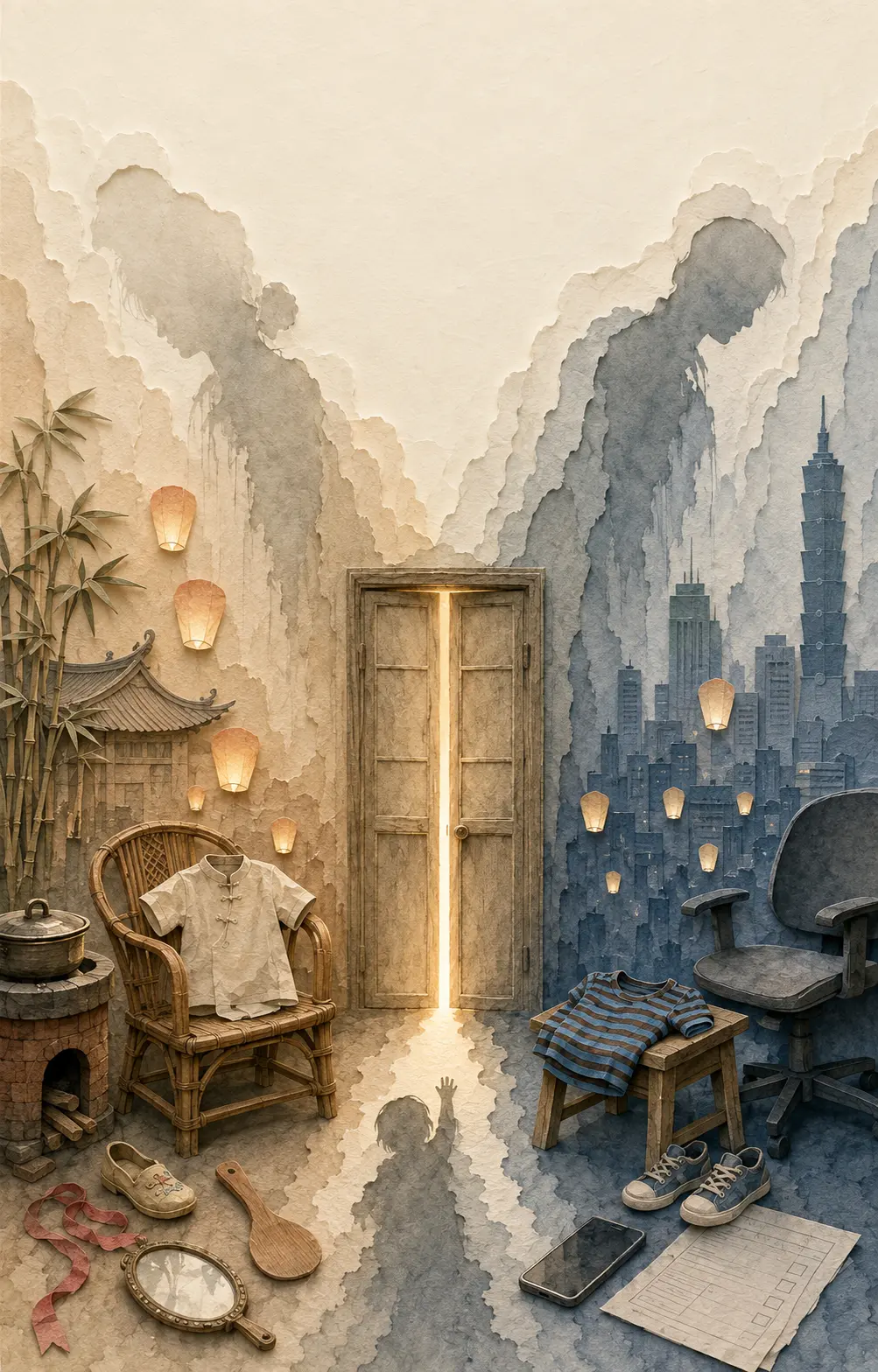
A bamboo chair preserved a child's name
FOLKLORE VERSIONTaiwanese folk tradition tells of Yi-á-koo (椅仔姑, literally the “Chair Maiden”), also invoked in a ritual known as Kuan Sam-koo. In different versions, the girl is called Sam-koo, or “Third Maiden,” and is said to be about three years old. Some stories say she was orphaned and sent to live with her elder brother and sister-in-law; others say she lost her mother young and was raised by the sister-in-law.
The variants share a cruel core. A toddler who still needed adult protection was forced to perform work far beyond her age: feeding the kitchen fire, cooking and completing household chores. If she was too slow, she was scolded, starved or beaten. Some tellings say she was tied to a bamboo chair; others say she was made to remain beside the stove, even at night. One morning, the adults discovered that she had died in the chair.
The legend says she was denied a proper burial and hidden beneath a pig trough. Her abusers imagined that concealing the child would also conceal what they had done. Yet Sam-koo returned with the chair; fear consumed them, and both eventually died.
The folk ending—wrongdoing followed by retribution—gives a late form of justice to a child whom no one rescued and no court is known to have heard.
What the historical record can and cannot establish
Yi-á-koo is not a Qing-era court case with an identifiable file. Existing sources do not supply a verified name, date or crime scene, nor a record of official investigation or trial. The National Museum of Taiwan History notes that the tradition appeared in the Japanese-period journal Minzoku Taiwan; one account came from a woman originally from Lukang who had married into Wanhua. The Dictionary of Taiwan Literature records the ritual as circulating widely among Hoklo communities.
We may say that the story circulated in Lukang, Wanhua and elsewhere in Taiwan. We cannot claim that an actual crime occurred in Lukang.
Only after death did people begin to ask her questions
RITUAL MEMORYIn the Kuan Sam-koo ritual, participants invite the Chair Maiden using a bamboo chair, rice paddles, clothing, rouge or flowers. The motion of the chair, or the number of taps made by a rice paddle, is interpreted as an answer about weather, marriage, relatives or the future.
After death, the legendary child could seemingly answer everyone. While she was alive, no one stopped to ask:
Are you hungry?
Where did those injuries come from?
Are you frightened?
Do you need someone to take you away?
People invited her in, listened and waited for answers only after she had become a spirit. When rescue might still have been possible, no one answered her. The bamboo chair therefore becomes more than a ritual object: it is the symbol of a child trapped and waiting for an adult hand.
In death, she answered other people's questions. In life, no one answered her plea.
A modern chair, and a child who truly lived
FINAL FINDINGS + COURTROOM MATERIALCenturies later, in a Taiwan equipped with child-protection laws, licensed childcare, social-work visits and formal safeguards, another heartbreaking name appeared: Kaikai. He was not a character in a legend. He was a real child.
Kaikai was not yet two and was waiting for an adoption placement. On 1 September 2023, he entered full-time care with a cooperating nanny. A child that young cannot choose a caregiver or leave danger on his own. His safety depends entirely on adults and the systems surrounding them.
The final judgment found that licensed nannies Liu Tsai-hsuan and Liu Ruo-lin jointly abused, injured and restricted Kaikai's liberty from 4 September through the evening of 23 December 2023. Official court material records that he was bound with towels, blindfolded with a mask, made to stand wearing only a diaper, forced to lie in positions he could not freely change, placed in a bucket while bound, bathed in cold water and given food insufficient for his daily nutritional needs.
Open-court reporting further described images and questioning concerning the child naked or wearing only a diaper, with limbs secured by towels, cloth or straps to a wooden stool, wooden chair or the base of an office chair, and with his eyes or mouth and nose covered. These specific details are presented as material shown or examined in court. The formal judgment and official court release remain the authority for the final findings of fact.
What the courts conclusively found
The defendants saw that the child was growing thin and had visible injuries, yet did not proactively obtain appropriate medical care. At death, Kaikai had at least 42 abusive injuries. Long-term physical harm, psychological abuse and malnutrition had devastated his body and mind. In the early hours of 24 December 2023, he died from hypovolemic shock.
When a toddler is physically restrained, cannot see clearly and does not yet possess the words to make a full report, the duty to protect him cannot be placed on the child himself.
No one reached that room in time to lift him out of danger.
Two chairs do not carry the same kind of evidence
SOURCE DISTINCTIONYi-á-koo and Kaikai must not be treated as two cases of the same evidentiary kind. Placing them together does not turn folklore into history, nor replace legal proof with a ghost story. It is a cross-era comparison that exposes the same child-protection question.
Yi-á-koo
She exists in oral accounts, ritual practice and variant legends. No modern judicial file is known. Later storytellers provide justice through imagined retribution.
The Kaikai case
Photographs, video, messages, medical evidence, witnesses and judgments were examined through a lay-judge first trial, High Court appeal and Supreme Court review.
- One child suffered in a legendary era with no child-protection system.
- One suffered in a modern state with laws, childcare and visitation mechanisms.
- One received only folklore's imagined retribution; the other received a real criminal judgment against the direct abusers.
- In both stories, society listened only after the child had died.
Different centuries, different evidence, different institutions—yet the same question: why did no door open while rescue was still possible?
The courts delivered a judgment, but could not return the child
JUDICIAL DECISIONTaipei District Court lay-judge panel|First instance
Both defendants were convicted of jointly and intentionally committing an adult's offense against a child—interference with liberty by abuse resulting in death. Liu Tsai-hsuan received life imprisonment and lifetime deprivation of civil rights; Liu Ruo-lin received 18 years.
Taiwan High Court|Second instance
The appeals were dismissed and the original sentences affirmed.
Supreme Court|Final
The final appeals were dismissed. The life sentence and 18-year sentence became conclusive.
Why was this not intentional homicide? Why was there no death sentence?
Public anger at prolonged, repeated cruelty is understandable. The legal distinction, however, matters: the maximum punishment for the offense of final conviction was life imprisonment. The court was not choosing between death and life under that offense. A homicide conviction would require proof that the defendants possessed homicidal intent; the severity of injury or the tragedy of the result cannot alone establish that mental element.
This does not end legitimate debate. Society may examine how abuse resulting in death is defined and punished, whether sentencing rules are adequate, and whether judgments are explained accessibly. Reform must begin with accurate facts and law, rather than allowing outrage to substitute for proof.
A final judgment against the abusers does not end every responsibility
LAYERS OF RESPONSIBILITYThe direct criminal responsibility of Liu Tsai-hsuan and Liu Ruo-lin is now conclusive. But Kaikai was receiving formal adoption services and full-time care, with visitation and supervision expected. Punishing the direct abusers does not answer every question about childcare management, visits, reporting, supervision, follow-up of warning signs or coordination across systems.
Direct criminal liability
The abuse and joint-offender responsibility established by final judgment.
Other individual liability
Participation, omission, concealment or obstruction must be proved person by person through the proper process.
Professional and institutional duty
Visits, supervision, reporting and records should be examined against each role and the information actually available.
System responsibility
How the protection network failed to catch the child remains a public question after sentencing.
Responsibility cannot be imposed by blood, marriage or co-residence. Being related to a defendant does not prove knowledge or involvement. If concrete evidence indicates that a person concealed conduct, deleted evidence, made false statements or obstructed the truth, investigators and courts should determine that responsibility lawfully.
The first-instance court release stated in its sentencing discussion that Liu Ruo-lin deleted chat records after the offense. Any allegation that other people or institutions backfilled, distorted or concealed records must still be determined individually from public evidence and the relevant proceedings; it should not be declared as guilt in advance.
Legal responsibility must be individualised. System responsibility must not disappear merely because individuals were sentenced.
The most frightening thing is not a ghost from folklore
SYSTEM QUESTIONSThe Yi-á-koo legend hides the child under a pig trough: an image of harm being buried. A modern society must not permit deleted messages, inaccurate records, rationalised abnormalities or agencies shifting blame to bury the truth again.
The most frightening thing is not the wronged spirit of an old story. It is that, even with child-protection law, social workers, licensed caregivers, visit records and risk tools, warning signs may still be missed. The system existed, but no one opened the door in time.
- Did each visit truly see the child, or merely complete a form?
- Should toddlers in full-time transitional or pre-adoption care receive more frequent unannounced visits?
- When weight, injuries, behaviour and a caregiver's account conflict, who escalates the risk?
- How can information move effectively among social work, childcare, medicine and government?
- When a child cannot speak for himself, how does the system read distress in his body, behaviour and development?
A toddler cannot write a petition or call the police. He may not even be able to finish the sentence, “Someone is hurting me.” Adults and institutions must see danger before the child can name it—and act faster than the harm.
Do not let Kaikai become a modern Chair Maiden
CALL TO ACTIONNever Forget the Tragedy
Called, memorialised and mourned by millions after death—yet while alive and suffering, unable to reach one person who would carry him away.
Children do not need tears that arrive only after death, or only demands for the harshest punishment once tragedy is complete. They need someone, while they are still alive and waiting, to notice the anomaly, believe the warning, open the door and remove them from danger.
A judgment can assign criminal liability but cannot bring a child back. A memorial can preserve a name but cannot replace rescue. What we can do for Kaikai is not merely remember what happened to him; it is ensure that the next child's wordless distress is not missed by the system.
The child can no longer speak, but the truth will speak for him. Harm may be hidden for a time; it cannot forever escape evidence, law, society and history.
We cannot change Kaikai's ending.
We can decide whether the next child's door opens in time.