Doors, calendars, corridors, judgments, and statutes replace any reenactment of a child or defendants.
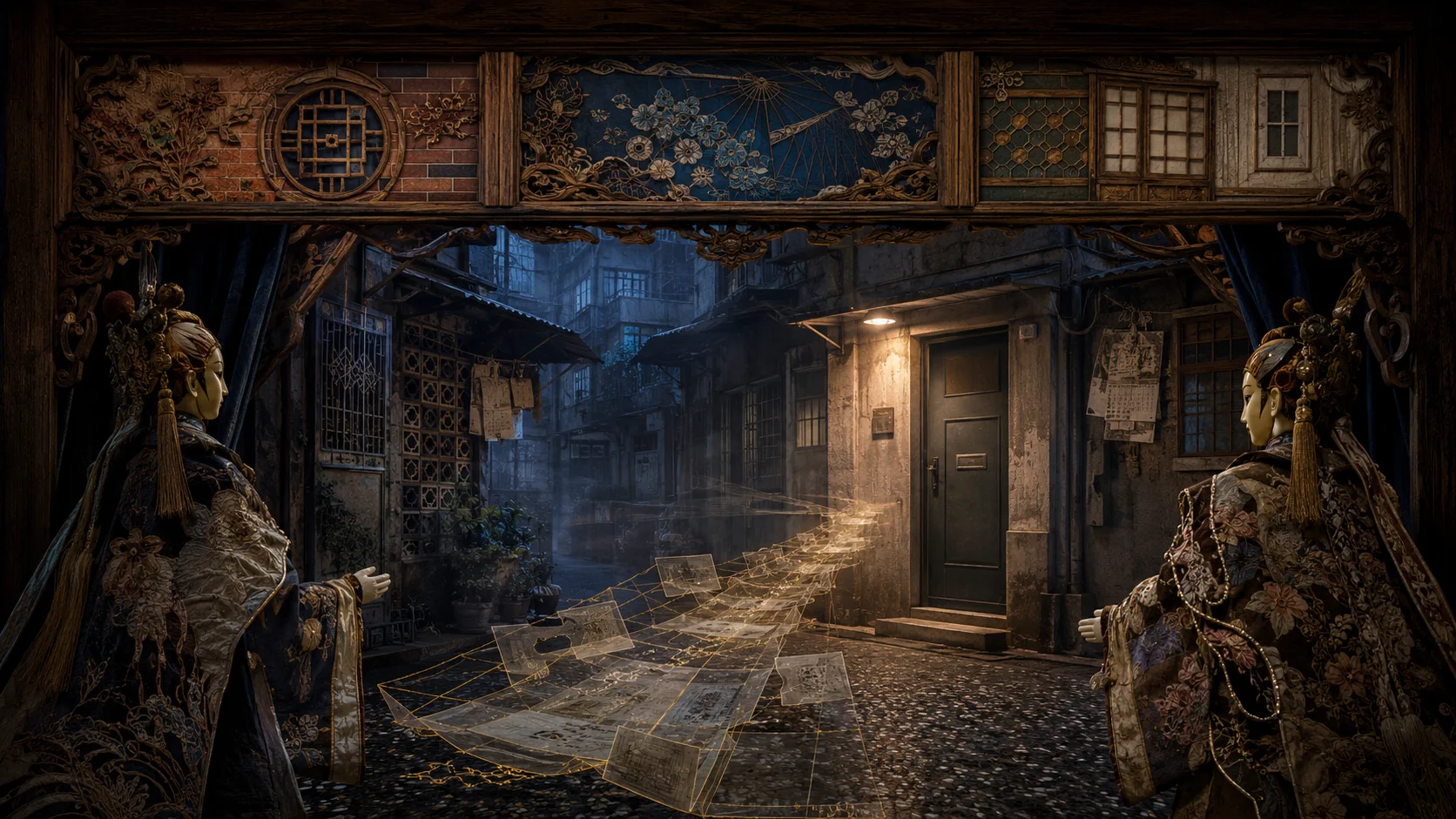
A LAW ON PAPER · A DOOR TO REACH · DAWN APPROACHING
Once his name entered type,
someone still had to stand outside the door
The Wang Hao Case | Twenty-one days apart, divided judgments, and Article 54-1
Wang Hao was two years and five months old. His name later remained in the public name given to a legal provision. This page does not reenact the harm. It keeps the final judgments, the Prosecutor General’s argument, the family and public response, and the legal history in their proper evidentiary places.
Criminal judgment final | Article 54-1 in force | Institutional history under continued review
Sound is off by default. Once started, the original score continues throughout the reading experience.
COMBINED FOUR-LANGUAGE VIEWS…views
PROLOGUE · BEYOND THE PAGE
An address is one line.
Reaching it is a road someone must finish.
A case file has a quiet order: name, charge, date, number. Yet when an adult is wanted, detained, ordered into drug observation or treatment, or imprisoned, life outside that page may lose a point of support at the same moment.
A child does not appear inside the adult’s offense, but may bear every disruption created by the adult’s judicial status. The child cannot add, “I am still here,” to the record. The state must therefore ask: Is there a child at home? Who is caring for that child? Has anyone actually seen them?
READING PROTOCOL · EVIDENCE BEFORE EMOTION
Identify who said what.
Then ask what the system left behind.
The criminal judgment is final, but “final” does not erase public controversy. Criminal responsibility follows the final judgment. Criticism of its reasoning is labeled by source and is never rewritten as a court finding.
Participation, offenses, sentences, and cause of death are grounded in the judicial record.
The High Court, extraordinary appeal, and family or civic response retain distinct labels.
Article 54-1 begins inquiry and reporting; seeing the child and closing the handoff still require scrutiny.
Final judgmentPrior judgmentProsecutor General’s argumentFamily/civic advocacyLegislative or agency recordInstitutional question
Content notice
This page contains restrained text about violence against a child, forced drug administration, and death. It contains no body, injury, identifiable image, or audiovisual reenactment.
WHAT HAPPENED · THE EVENTS BEFORE THE LAW
Four points in time clarify how Wang Hao left his ordinary life—and which acts must not be collapsed together.
October 11 to November 1, 2011 are twenty-one days apart, or twenty-two calendar dates when both endpoints are counted. This wording does not imply a formal missing-person report or agency designation.
Who is who
Two years, five months; always the person to be protected.
Imprisoned in an unrelated case at the time; the cited finding does not identify the month or offense.
Moved with Wang Hao into Liu’s residence in September; not one of the four defendants.
Abducted the child with Zhou; repeatedly injured him and joined both drug offenses.
Abducted the child with Liu; repeatedly injured him and joined both drug offenses.
Did not know when the child was brought into his home on October 28; later joined the methamphetamine offense.
Later joined the heroin offense, including the final injection.
FINAL JUDGMENT · LEGAL HISTORY
Care arrangements changed; the father was in prison in another case
Wang Hao’s mother brought him to live at Liu’s residence. His father was then imprisoned in an unrelated matter and could not exercise supervision. “September 2011” describes when the mother and child moved—not a judicially established month or reason for the father’s imprisonment. Article 54-1 did not yet exist and cannot be retroactively treated as applicable.
FINAL JUDGMENT
Liu and Zhou jointly took Wang Hao away
Claiming they were going shopping, Liu and Zhou took him first to Zhou’s residence; both were convicted of joint abduction. They moved him to Xu’s residence on October 28. The judgment specifically found Xu did not know when the child was brought in. The four defendants cannot be described as jointly controlling him from day one.
FINAL JUDGMENT
Twenty-one days apart: under Liu and Zhou’s control
10/110203040506070809101112131415161718192011/1
Wang Hao remained under Liu and Zhou’s effective control. Xu and Zheng participated only in specified later acts after October 28. The final judgment grouped participation carefully: Liu and Zhou repeatedly inflicted injury; Liu, Zhou, and Xu joined the methamphetamine offense; Liu, Zhou, and Zheng joined the heroin offense.
Open: bodily injuries recorded in the final judgment (sensitive content)
What remained on his body was not a single moment, but time that no one stopped soon enough
The final judgment records that after Wang Hao was taken away from his mother, his head and face, limbs, and torso bore multiple abrasions, contusions, areas of swelling, and scabbed wounds of differing ages; his fingertips and nails were also injured. In a court record, these appear as restrained clinical terms. On the body of a young child, they are no longer merely a list: recent and older injuries remained at the same time, reading not as the trace of one moment, but as time that no one stopped soon enough.
He was later forcibly administered heroin and methamphetamine. Once the record is closed, these injuries should not become a tableau of suffering for others to inspect. They are closer to a letter folded again and again, never delivered in time; each crease asks why protection did not arrive earlier.
The forensic evidence and the court also distinguished between the injuries to his body and the cause of death recognized in law. The multiple blunt-force injuries were not directly fatal; the final judgment accepted toxic shock from the combined effects of heroin and methamphetamine as the cause of death. The account stops here. These details remain so that responsibility has a verifiable outline, not so that a child’s pain becomes a spectacle.
FORENSIC MATERIAL ACCEPTED BY THE FINAL JUDGMENT
Hospital and death
Wang Hao was taken to hospital. The accepted forensic evidence attributed death to toxic shock caused by the combined effects of heroin and methamphetamine. He had no breathing or heartbeat before arrival and could not be resuscitated. The fact that medical help was eventually arranged was one circumstance in the dispute over intent; it was not timely treatment and did not erase the criminal responsibility finally imposed.
CASE & LAW AT A GLANCE
The case, in six careful facts
Some early reports used “three-year-old” as a rough description; this page follows the judgments and case record.
Twenty-one days apart; twenty-two calendar dates if both endpoints are included.
The Supreme Court rejected the third-instance appeal for failure to satisfy legal procedural requirements.
Combined sentences for all offenses tried together; Liu’s and Zhou’s include other drug and firearms crimes.
Passed July 26 and promulgated August 8, 2012—before the judgment became final in 2013.
An extraordinary appeal is not a routine fourth trial, and an advocate’s claim is not a finding.
TWO TRACKS · ONE CHRONOLOGY
Litigation and reform ran in parallel.
The law came before final judgment.
Article 54-1 was created after the events as an early-warning mechanism. It cannot be written backward into 2011, nor can anyone promise it would certainly have prevented the outcome.
Track A | Case and courts
Liu and Zhou jointly take Wang Hao away.
Hospital and death.
First instance: death, life, fourteen years, thirteen years.
High Court changes portions; aggregate sentences become 30, 20, 14, and 9 years.
Third-instance appeal dismissed on procedural grounds; High Court judgment becomes final.
Extraordinary appeal dismissed; later retrial effort also denied.
Track B | Law and institutions
Legislature passes Article 54-1.
Article 54-1 is promulgated.
Judicial Yuan establishes court inquiry workflow and forms.
Criminal Code Article 286 is amended; it, too, was sometimes called the “Wang Hao provision.”
Further abuse-penalty reforms form a broader history and are not all direct results of this case.
JUDGMENTS · PROCEDURE MATTERS
What changed from the first judgment to finality?
| Stage | Date and docket | Result | How to read it |
|---|---|---|---|
| District Court | 2012.06.27 Taipei District Court 101-Chung-Su-1 | Death for Liu, life for Zhou; 14 and 13 years for the others | Murder findings as to some defendants; not the final result. |
| High Court | 2013.01.29 Taiwan High Court 101-Chu-Shang-Chung-Su-33 | Aggregate sentences: 30, 20, 14, 9 years | Reclassified the relevant conduct under offenses including injury causing death and forced drug administration; this became final. |
| Supreme Court | 2013.07.10 102-Tai-Shang-2742 | Appeal dismissed | The third-instance grounds did not meet legal procedural requirements; the Court did not retry every fact. |
| Extraordinary appeal | 2013.12.12 102-Tai-Fei-439 | Dismissed | A special remedy, not a routine “fourth instance” or automatic factual retrial. |
Keep each legal voice in its proper column
The High Court evaluated purpose, proof of dose, foresight of death, and subsequent conduct, concluding that murderous intent had not been proved beyond the required standard. The Prosecutor General argued that the reasoning may be contradictory because the defendants’ familiarity with drug danger sat uneasily beside the conclusion on foresight. That criticism is an argument in the extraordinary appeal—not a second conviction.
Sentence clarification
The 30-, 20-, 14-, and 9-year terms are aggregate sentences across offenses tried in the same case. Liu’s and Zhou’s totals also include other drug and firearms offenses. They are not stand-alone sentences for the Wang Hao-related conduct. Nor was an apology or bow a single “escape from death” switch.
ARTICLE 54-1 · FROM FILE TO DOOR
Article 54-1 is not a memorial phrase.
It is a duty to inquire and report.
Article 54-1 of Taiwan’s Protection of Children and Youths Welfare and Rights Act was passed on July 26 and promulgated on August 8, 2012. When a child’s actual caregiver violates drug law and enters one of six specified judicial statuses—wanted, detained, under observation, in rehabilitation, in compulsory treatment, or imprisoned—designated police, prosecutors, or courts must inquire into the life and care of any child under twelve. Statutory risk must be reported to the local competent authority.
Identify the actual caregiver and statutory judicial status.
Name, age, actual care relationship, and possible location.
Assign responsibility and record time, method, and result.
Do not rely only on a third party’s account.
Report abuse, neglect, or inadequate care as required.
Confirm receipt, assessment, and follow-up service.
Three limits
It does not automatically remove every child connected to a drug case. Its formal child category is under twelve. “Wang Hao provision” is an informal name; a 2012 amendment to Criminal Code Article 286 has also carried that label in some reporting.
If the law truly remembers a child,
it must remember more than his name. It must find the next door.
ACT ONE · LEAVING A NAME
Before he became a case number
A file can hold charges and dates. They must not cover the child’s name.
CHAPTER 01 · A CHILD BEFORE A CASE
Before the law wrote anything, he was a child
Wang Hao was two years and five months old. The record gives us that much, and it is enough to demand restraint. We invent no favorite toy, speech, inner life, or relic. Neither his injuries, a docket number, nor a statute should replace his name.
Public memory often compresses a child into a case title. This chapter lets the case number recede and first recognizes a young child who was entitled to care and unable to summon a system by himself.
Can a society remember both the provision named after him and the child who came before it?
ACT TWO · TWENTY-ONE CALENDAR CELLS
Days outside the reach of ordinary care
The calendar is not a countdown. It preserves the distance help did not cross.
CHAPTER 02 · OUT OF REACH
How a child left the ordinary lines of help
After Liu and Zhou jointly took him on October 11, Wang Hao remained under their control. Xu and Zheng only participated in specified acts later, after October 28. Describing all four as one group from the outset would erase the court’s distinctions of time and conduct.
The twenty-one cells do not count down to death or imply a formal missing-person process. They preserve a public question: when a young child cannot return home, state an address, or identify danger, which everyday relationships might notice, and which institution should act?
When a child leaves an ordinary pattern of life, who can notice—and who carries the signal to someone able to act?
ACT THREE · THE CORRIDOR ENDS
The hospital was the last road
The camera stops at the corridor. It reenacts neither resuscitation nor grief.
CHAPTER 03 · THE CORRIDOR
Before arrival, treatment was already too late
The forensic evidence accepted in the final judgment attributed Wang Hao’s death to toxic shock caused by heroin and methamphetamine acting together. He had lost signs of life before reaching hospital. We state only what is necessary to understand cause of death and the legal dispute.
Arranging transport to hospital was one circumstance in the High Court’s assessment of intent. It was not timely treatment and did not erase responsibility for the preceding acts. Arguments about delay, foresight, and later forensic opinion remain clearly attributed.
How can a faint sign—“there may be a child”—become a real visit before an emergency?
ACT FOUR · THE JUDGMENT DIVIDES
The law used different names
Trial, appeal, finality, and extraordinary appeal cannot be reduced to “the sentence changed.”
CHAPTER 04 · DIVIDED JUDGMENTS
The divide concerned evidence and intent
The first court found murder as to some defendants. The High Court evaluated purpose, proof of dose, foresight of death, and later conduct, then classified the conduct under offenses including injury causing death and forced drug administration. The Supreme Court dismissed the third-instance appeal on procedural grounds, making that judgment final.
The Prosecutor General’s extraordinary appeal challenged the logic; it was dismissed. The family later presented a new forensic opinion and sought retrial, which was denied. The site preserves those disagreements without supplying a verdict of its own.
How can the public criticize a judgment without flattening procedure and proof into a slogan?
ACT FIVE · TYPE MEETS PAPER
His name became Article 54-1
What matters is not a memorial title, but how the state finds the next child.
CHAPTER 05 · HIS NAME IN THE LAW
From a commemorative name to executable verbs
Article 54-1 was enacted after the events but before the criminal judgment became final. It requires inquiry when a caregiver enters specified judicial statuses because of a drug offense, and reporting where statutory risks such as abuse, neglect, or inadequate care are found.
A name can gather memory. A workflow determines whether protection happens: locate the real residence, see the child, confirm receipt across jurisdictions, and escalate inconsistent information. Every verb is closer to the law’s purpose than a title on a door.
Without a named worker, deadline, sighting record, and confirmed handoff, can “must inquire” still stop on paper?
ACT SIX · THE VISIT BECOMES A ROAD
The institution arrives
An address is a location. Seeing the child begins a real safety check.
CHAPTER 06 · THE VISIT MUST ARRIVE
A closed loop is not “we asked.” It is “we confirmed.”
After Article 54-1 took effect, the Judicial Yuan created urgent and ordinary inquiry paths. Information suggesting inadequate care calls for immediate reporting. An incomplete file still calls for inquiry by someone familiar with child protection; “insufficient information” is not a reason to close the matter.
Training materials emphasize that the worker must see the child and assess food, clothing, housing, movement, education, and medical care. “Someone on the phone said the child was fine” has a different evidentiary value from an actual sighting and confirmation of care.
- TRIGGER
- What statutory status, found when?
- CHILD
- Who cares for them, and where are they?
- SIGHTING
- Who saw the child, when, and in what condition?
- HANDOFF
- Which agency accepted and followed up?
When the next adult case file appears, can the gold line finally cross the whole distance to the door?
SOURCES · PRIMARY TEXTS, LABELED POSITIONS
How this page knows—and how it admits what it does not know
Facts, offenses, and sentences rely on judgments. The Prosecutor General’s filing supplies the extraordinary-appeal criticism; it is not a court finding. Current law comes from the official legal database, and implementation from Judicial Yuan materials. News supplements later activity but does not replace judgments.
FIRST INSTANCETaipei District Court, 101-Chung-Su-12012.06.27CORE FINAL FACTUAL JUDGMENTTaiwan High Court, 101-Chu-Shang-Chung-Su-332013.01.29THIRD INSTANCESupreme Court, 102-Tai-Shang-27422013.07.10EXTRAORDINARY APPEALSupreme Court, 102-Tai-Fei-4392013.12.12PROSECUTOR GENERAL’S ARGUMENTSupreme Prosecutors Office filingLegal criticismCURRENT LAWProtection of Children and Youths Welfare and Rights Act, Article 54-1Recheck version at publicationLEGISLATIVE HISTORYLegislative Yuan | Third reading2012.07.26IMPLEMENTATIONJudicial Yuan | Article 54-1 inquiry workflowUrgent and ordinary pathsTRAININGJudicial Yuan | Seeing the child and daily-life domainsFood, clothing, housing, travel, learning, healthLATER PROCEDUREConstitutional Court Order 111-Shen-Tsai-412022 constitutional-review petitionHELPMinistry of Health and Welfare | 113 Protection Hotline24 hours
Classical quotations are brief public-domain thematic reflections, not case evidence. Taiwanese and Hakka lines are original editorial transitions, not proverbs, songs, or words spoken by a case participant. Sources accessed August 16, 2026.
IF A CHILD MAY BE IN DANGER IN TAIWAN
Record what you can observe, and let trained services act
If you believe a child in Taiwan may face abuse, neglect, or inadequate care, note the time, place, and objective circumstances. Do not force entry or confront a suspected abuser yourself.
Consultation and reporting for child protection, domestic violence, and sexual violence.
Use 110 when harm is occurring or a person faces imminent danger.
FINALE · THE EAST GROWS LIGHT
Dawn is near.
Someone must still finish the road.
Wang Hao’s name remains in public memory and in the informal name of a legal provision. But the law’s weight lies not in four commemorative characters. It lies in the next file: someone identifies the child, finds the address, sees them, completes the report, and confirms that another pair of hands has taken responsibility.
The Empty Chairs at Dawn | Original score for this feature (confirmed by the project owner)
Minnan mosaic craft, Hakka indigo, and military-dependents’ village lanes, trees, and letters appear only as shared Taiwanese cultural memory. They do not assign ethnicity to anyone in the case.