
Skip to the article

A PAPER LEFT THE CLASSROOM · FIVE SCENES

Scene One | A winter classroomA questionnaire waited on a desk. The light outside was thin, like a letter not yet sent.

Scene Two | She wrote the danger downA ten-year-old used no difficult words. She only needed one adult to stop and finish reading.

Scene Three | The long corridorSchool, board of education, child guidance centre. Every door had a name; none kept the danger out for good.

Scene Four | The plea was handed backThe paper reached the person she had accused. The words themselves became another risk she had to carry.

Scene Five | The paper remainsWe retrace its route not to watch a tragedy, but to recognise the next door that must be opened.

Silent animation · about 18 seconds · may be skipped
Child Protection Action AllianceREMEMBER · PROTECT · ACT
A JAPANESE CHILD-PROTECTION CASE | 2019 · NODA, CHIBA

The Mia Kurihara Case

The questionnaire that was not protected, and the winter she never finished

A ten-year-old wrote down what she could not safely say at home. The questionnaire left her desk, passed through a school, a board of education and a child guidance centre, and was ultimately disclosed to the father she had accused. This feature follows that paper trail while clearly separating verified facts, institutional analysis and memorial prose.

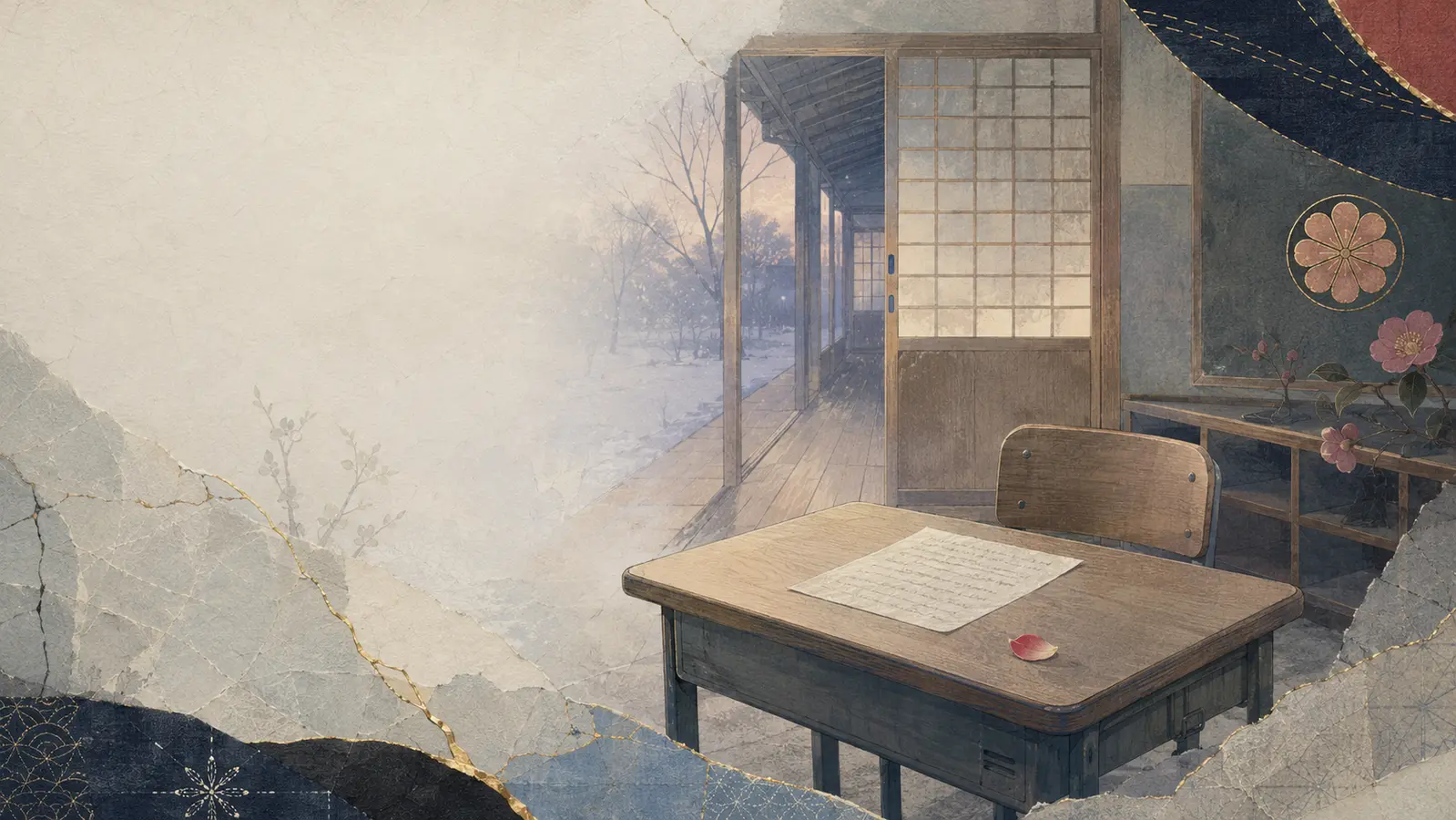
Memorial art showing an empty winter classroom, a questionnaire, washi, kintsugi and an original ten-petal guardian chrysanthemum
ART DIRECTIONWashi fibre, ukiyo-e lines, the restraint of a Noh stage, abstract kabuki curtain colours, kumiko, sashiko and kintsugi. No violence is reconstructed; only a sheet of paper waiting to be protected remains.
ARTICLE GUIDE

How to read this feature

About 12–15 minutes. Blue boxes contain verified facts; pale red boxes contain memorial prose; green boxes identify system issues. Begin with any chapter.

See the child before the case

Severe child-abuse cases are easily compressed into familiar terms: report, visit, release from protection, institutional failure, sentence. Mia was not made of those terms. She went to school, wrote, waited for the day to end, and trusted that a blank space on a questionnaire might lead to an adult willing to believe her.

This page therefore does not turn injuries into spectacle. Necessary judicial facts remain, but the focus is on what adults and institutions knew, decided and failed to do. The literary passages preserve the presence of a child beyond the procedural record.

READING PRINCIPLE

Narrative does not alter facts, and remembrance does not replace accountability. Dates, interventions and court outcomes are based on public judgments and official review materials. Reflective passages are visually labelled.

WASHIFine fibres hold one another so the paper will not tear

Child protection likewise depends on schools, social services, police and medical information becoming one strong sheet, not separate fragments.

She wrote what she could not say at home

In November 2017, Mia disclosed her father's violence in a school questionnaire. It was not a vague hint but a direct request for help. The school confirmed the disclosure and reported it; the Kashiwa Child Guidance Centre placed her in temporary protection. At that moment, the system did catch her.

お父さんにぼう力を受けています。先生、どうにかできませんか。Meaning: My father is being violent toward me. Teacher, can you do something?
VERIFIED FACT

The official review treats the questionnaire, report and temporary protection as critical starting points. The danger was not information discovered only after her death; the warning existed early and in her own words.

MEMORIAL PROSE

While her pencil moved, the classroom probably kept making ordinary sounds: chair legs on the floor, a door closing far away. She placed something extraordinary inside an ordinary school day, then waited for the day to change.

Fifty days were not safety; they were a pause

Temporary protection lasted about fifty days. After it ended in late December 2017, Mia stayed for a time with relatives and later returned to her parents. Ending protection should require a full risk assessment, integrated information and a sustainable safety plan. The review found gaps in those judgments and connections.

For an agency, fifty days may be a period of intervention. For a child, it is fifty mornings of needing to know whether today will be safe.

SASHIKOProtection is not one stitch; the stitches must continue

One placement, one phone call or one meeting cannot carry a child. Every following point needs a named person to verify safety and continue the thread.

MEMORIAL PROSE

A calendar turns without sound. The fiftieth day looks much like the forty-ninth, yet once a particular door closes, the rooms on either side belong to different seasons.

A protected disclosure was handed to the person accused

In January 2018, Mia's father repeatedly demanded the questionnaire. Under pressure, the Noda Board of Education gave him a copy and later acknowledged that doing so was wrong. The question was not merely whether an administrative document could be disclosed. It recorded a child's allegation of violence inside her home.

Once the disclosure reached the accused adult, the child knew that her words were no longer protected. Managing a child's disclosure must begin with the practical risk of retaliation or coercion, not with routine document handling.

SYSTEM FOCUS

Confidentiality is a safety intervention. Who may read a disclosure, when it may be shared and who authorises that decision must be governed by explicit risk assessment.

URUSHIEach layer should add protection, not concealment

Like layers of lacquer, every professional contact should strengthen the record. New paperwork must never cover an earlier warning without explaining why the risk changed.

Later words cannot automatically cancel the first plea

After her father obtained the questionnaire, statements appeared denying abuse and asking to return home. The context presented in court and review materials requires a different question: under what supervision, fear and power relationship was each statement produced?

For a controlled child, “I am fine” may be a way to make immediate pressure stop. Professional assessment must examine the conditions that produced a recantation rather than treating it as a convenient end to concern.

MEMORIAL PROSE

The first paper was a hand reaching beyond the door. The second was that hand being gently pushed back. Both survive, but only one was written before the door closed.

KINTSUGIRepair does not pretend the fracture never happened

Institutional repair must leave the path of failure visible—its decisions, responsibilities and changes—instead of covering an old mistake with a new form.

Contact continued while the child moved out of sight

Mia's absences, family circumstances and known risks did not produce a sustained joint decision to see her directly. A call can be answered, a parent can offer an explanation and a file can be completed. None of those actions is the same as seeing the child.

Mia died at home on 24 January 2019. She was ten. The court found that she had been subjected to sustained violence and severe treatment before her death. This page does not catalogue every injury; understanding institutional failure does not require repeatedly consuming a child's final suffering.

DIRECT SAFETY CHECK

The person who must be seen is the child. Prolonged absence, blocked access or an inability to interview her privately should raise the risk level, not be neutralised by a parent's telephone account.

MEMORIAL PROSE

January light disappears early. Other children packed their books, crossed the school gate and returned to dinners and lit rooms. She did not finish that winter. Every January since contains one empty chair.

The court counted sentences; society must count lost chances

A lay-judge panel at the Chiba District Court sentenced Mia's father, Yuichiro Kurihara, to sixteen years' imprisonment for causing death through injury and related offences.

After appellate proceedings, the sixteen-year sentence became final.

Nagisa Kurihara received two years and six months, suspended for five years with supervision, for failing to stop and assisting parts of the abuse. The court also considered the domestic violence and coercive control she had endured.

Criminal judgments address individual liability. They cannot alone answer why information did not connect, how frontline staff should resist coercive pressure, or who must follow a child after temporary protection ends. Those questions belong to administrative review and durable reform.

TWO LEVELS OF RESPONSIBILITY

Recognising how domestic violence constrained the mother's actions does not erase legal responsibility. Holding individuals responsible does not erase institutional responsibility. Both levels must remain visible.

The system did not vanish at once; one light went out after another

  • Temporary protection ended without an integrated judgment establishing that danger had passed.
  • Information, roles and escalation pathways did not connect reliably across agencies.
  • The board of education released a child's disclosure under pressure from the accused parent.
  • The coercive conditions surrounding later statements were not adequately recognised.
  • Absence and failure to see the child directly were not treated as reasons to increase concern.
  • Responding to a controlling parent displaced attention that should have remained on the child.
KUMIKOEvery wooden piece must carry the next

Inter-agency work cannot rely on goodwill alone. Reporting, convening, direct contact, escalation and supervisory decisions require precise, auditable joints.

After the case, change cannot end with an apology

Noda published reviews and introduced recurrence-prevention measures, including stronger inter-agency work, legal support for schools, a case-management system and response manuals. Their value is tested at the next difficult door: does a worker have the authority, resources and procedure to insist on seeing the child?

Mono no aware does not beautify death; it recognises what cannot be restored

In Japanese literature, mono no aware acknowledges that things pass and that some losses remain unreasonable even when understood. A falling flower is not therefore a cause for celebration. Because its season is brief, those entrusted with it must not arrive late.

露の世は 露の世ながら さりながら Kobayashi Issa, Oraga Haru

A free rendering: This is a dewdrop world—I know it is. And yet, and yet. Issa is associated with writing the verse after his young daughter's death. Its final hesitation preserves a grief that reason cannot dissolve.

The visual language uses a camellia petal, washi, a kintsugi seam and an original ten-petal guardian chrysanthemum. The emblem is not the Japanese Imperial sixteen-petal crest and represents no state body; its ten petals refer only to Mia's age and to every childhood that should be protected whole.

MOKUHANGALeave an impression so memory can be seen again

Each woodblock colour must be registered again. Historical case work likewise compares dates, records, judgments and institutional responses so failure is not worn smooth by time.

Before the next questionnaire, these lines cannot remain blank

  1. What non-negotiable threshold must be met before protection ends after a direct disclosure?
  2. Who protects a child's disclosure and assesses the new danger created by revealing it?
  3. When a child recants, who examines the conditions and power relationship behind the statement?
  4. How may frontline staff escalate immediately when a controlling parent blocks access or applies pressure?
  5. Why can a telephone call not replace seeing the child, and who authorises any exception?
  6. After an inter-agency meeting, which named person follows the child until safety is real?
  7. How are failures preserved, reforms made public and long-term implementation independently checked?
FOR THE READER

A child's plea must not become a letter sent to many addresses with no recipient. Next time, someone must sign for it—and stay until safety actually arrives.

Sources and editorial note

Court information is additionally compiled from public judgments and final-case reporting. Details of harm are limited to what is necessary to understand responsibility and institutional failure; literary passages are not verbatim historical records. Regional categories are for navigation only and do not express a position on sovereignty or legal status.

The paper remains. The child does not.

Mia did speak. She made the danger clear. Remembering her does not mean keeping her forever in the last winter. It means that when the next child writes for help, someone believes her, stays, opens the door and does not return her voice to danger.