
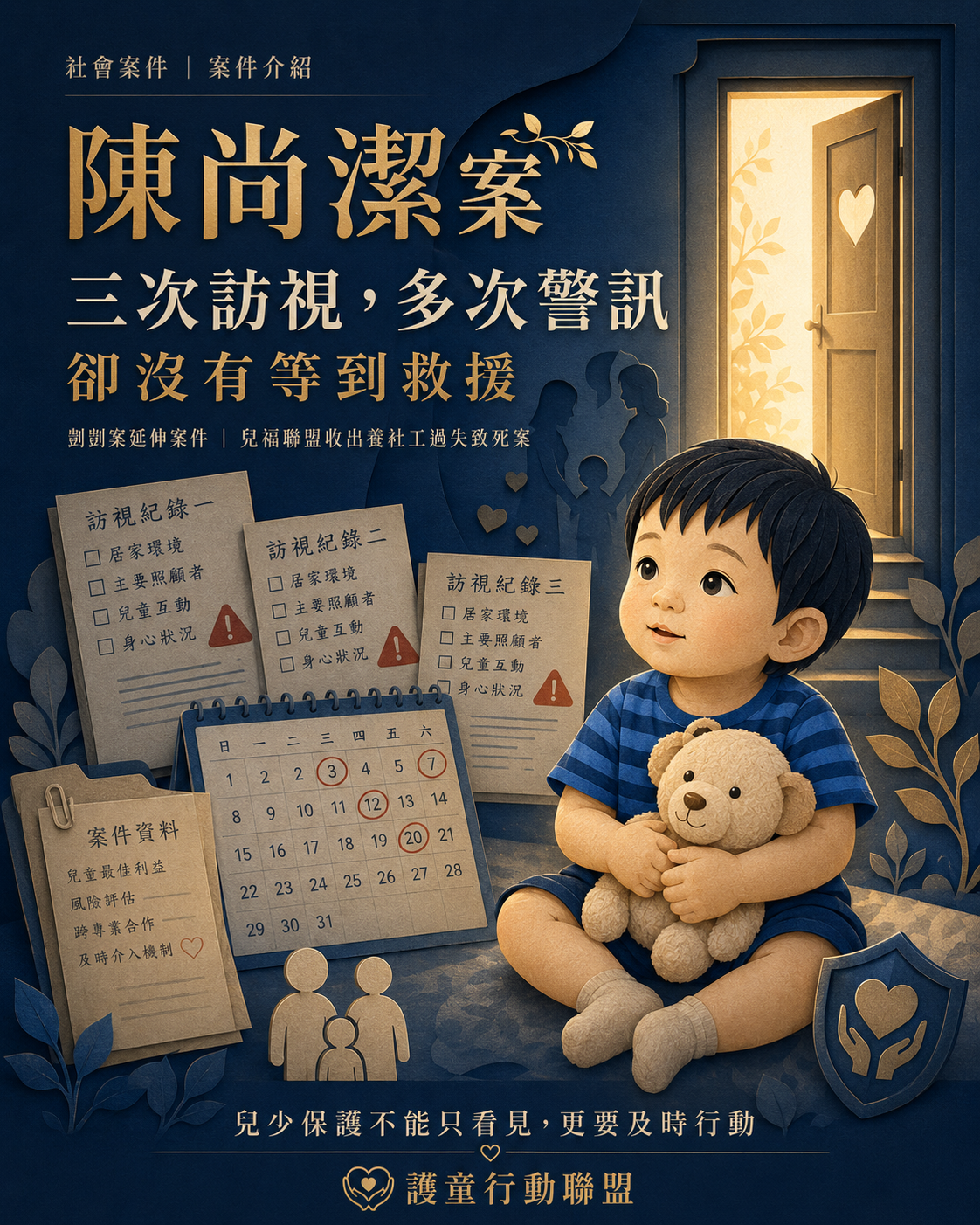
When children send out distress signals again and again
"He won't tell what happened to him.
But the bruises, weight loss, missing teeth, fear and one abnormality after another are actually asking for help on his behalf. "
On December 24, 2023, a boy under 2 years old, "Kaikai", died after more than three months of abuse.
It was the nanny Liu Caixuan and sisters Liu Ruolin who directly abused Kaikai. However, in the last few months of Kaikai’s life, another important question must be asked: What did the professionals responsible for tracking the adoption and child care status of the children see? What did you do again?
The Taipei District Court found in the First Instance that Chen Shangjie, a social worker of the Child Welfare Alliance who was in charge of the adoption case, had a substantive obligation to protect the child and had "guarantor status" for the child. She had learned about a number of major abnormalities during the three visits, but she did not further verify them, increase the frequency of visits, implement unscheduled visits, arrange necessary medical treatment or report them in accordance with the law.
Basic information of the case
2 years in prison
Guilty at First InstanceThe Taipei District Court determined that Chen Shangjie had a specific obligation to protect the girl, and that his inaction had a considerable causal relationship with the Death.
not guilty
Not guilty in the first trial, the prosecutor has appealedThe court held that the existing evidence was insufficient to prove that he had the criminal intention to deliberately create false business documents.
The Taipei District Prosecutor's Office filed an appeal on May 15, 2026, regarding the sentencing for negligent Death and the acquittal of forgery. Therefore, Chen Shangjie’s partial verdict has not been determined.
What is this case?
Kaikai entered the adoption process due to family care reasons and was referred to the Child Welfare Alliance.
After the Child Welfare Alliance took over the case, Chen Shangjie served as the adoption social worker. Subsequently, through the arrangement of the Children's Alliance, the child was handed over to the cooperating nanny Liu Caixuan for 24-hour full-day care starting from September 1, 2023.
However, after entering Liu Caixuan's home, Kaikai suffered long-term and severe abuse. The abuse identified by the Taipei District Court includes binding, blindfolding, standing naked for long periods of time, feeding inappropriate food, and other violent abuse. At the time of his Death, there were at least 42 injuries on his body caused by man-made violence, repeated and long-term abuse.
In the early morning of December 24, 2023, Kaikai finally died of hypovolemic shock due to systemic abuse injuries, long-term malnutrition and other factors.
The real core of the Chen Shangjie case occurred during these three months.
Three visits - the child's condition worsened step by step
first visit
Kaikai was given to Liu Caixuan for less than a month. The court found that Chen Shangjie had seen obvious large bruises on the child's forehead during the visit. Kaikai's condition began to show abnormalities compared to before he was placed in day care, but a complete investigation sufficient to rule out the possibility of abuse was not initiated.
second visit
A month later, the child appeared in front of Chen Shangjie again. Kaikai's face was obviously thin, his expression was lonely, and his eyes had lost their original look. After comparing the conditions before and after child care, the court believed that there was a huge gap in the child's appearance. For social workers with professional experience in child adoption and adoption, the causes of these changes in physical and mental conditions should be further determined.
third visit
By the third visit, the abnormalities were more concentrated. The court found that Kaikai had lost 3 to 4 teeth, had significantly thinning hair, had new and old bruises on his forehead, and had a thinner face. In addition, he had suffered from frequent fevers, allergies, and injuries. The court believed that these phenomena met multiple child abuse warning signs. However, there is still no effective external intervention.
What does the court think Chen Shangjie should do?
Chen Shangjie was not the one who directly committed violence against Kaikai. Therefore, what the court has to judge is not "Has she abused Kaikai?" but "Does she have a legal obligation to prevent the danger?" and "If she fulfills her obligations, is it likely that Kaikai's Death can be avoided?"
Taipei District Court’s final answer: Yes.
The Taipei District Court’s first-instance answer: yes.
What is "guarantor status"?
Generally speaking, a person who sees danger and fails to intervene does not necessarily need to be criminally responsible for the end result. However, some people have special "obligations to act" due to laws, contracts, positions, actual protection responsibilities, or the ability to control sources of danger. In criminal law, it is often called "guarantor status."
The court held that this case did not automatically require all social workers to bear criminal responsibility for the Death of the case because "Chen Shangjie is a social worker." Instead, it determined whether she had the obligation to protect the widow based on her authority, information control and actual division of labor in this specific case.
The court specifically pointed out that this judgment was directed at Chen Shangjie, who had substantial power of control but failed to perform his obligations, rather than making a general determination of criminal liability for the entire social worker professional group.
Why did the court determine that she had a duty to protect?
Children’s League is not just about introducing nannies
The court found that the Child Welfare Alliance has a considerable degree of power to select, manage and supervise the cooperative nannies. Cooperating nannies must be screened, reviewed, trained and managed, and have the obligation to repay; if they are unable to cooperate, Children's Alliance also has the authority to terminate the cooperative relationship.
She is someone who can actually enter a childcare environment
As a social worker who handles adoption cases, Chen Shangjie can actually enter the nanny's home, contact the caregiver and observe the living conditions. She is not someone who just sees the papers, but someone who can actually see the children.
She has complete information about the child’s condition before and after
The court believed that she was one of the few people who could piece together the information after knowing Chi Chi's growth status after birth, past physical examination data, environmental transformation process, appearance and mental state before child care, and major changes after child care.
There is an actual division of labor with other social welfare units
The court found that there was a division of labor between Chen Shangjie and the social worker of Shuying Social Welfare Center, which enabled her to actually assume an important role in tracking and confirming the status of the child care system; the name "lead social worker" itself was not the only key.
24-hour reporting obligation
The court also pointed out that in accordance with the relevant provisions of Articles 53 and 56 of the "Child and Juvenile Welfare and Rights Protection Act" at that time, professionals have corresponding reporting obligations in accordance with the law if they know that children have not been properly raised or cared for, need immediate medical treatment but are not receiving medical treatment, are suspected of being physically or mentally abused, or have suffered other persecution or harm when performing business.
The court held that the warning signs that appeared in this case were not just once, but continued to accumulate.
Key lapses identified by the court
Failure to fully verify the nanny’s statement
The court held that Liu Caixuan’s claims regarding some anomalies lacked supporting evidence from photos, videos or other objective data, but Chen Shangjie did not ask for further proof, nor did he fully check whether the claims were reasonable. Instead, he attributed some of the anomalies to the child’s past experiences or the previous nanny.
The child has frequent fevers and injuries, but no effective follow-up medical treatment
Faced with Kaikai’s frequent fevers, allergies, and injuries, the court pointed out that it did not effectively urge medical treatment, nor did it further confirm whether the injuries were properly treated.
No increase in visit rate
The child suffered repeated injuries within a short period of time, was noticeably thinner, had changes in mental status, suffered severe tooth loss, and had thinning hair. The court believed that the frequency of visits should have been considered to increase the frequency of visits to further confirm the child's safety.
Failure to implement no-book visits
The court listed "increasing the frequency of visits" and "implementing unscheduled visits" as one of the specific measures that could have been taken in this case to avoid seeing only the environment prepared by the caregiver.
There was no verification of the former nanny or objective information
The court held that it was possible to verify the former nanny, compare past physical examination records, compare physical conditions before and after child care, and confirm the true cause of the injury, but these objective checks, which could rule out the nanny's unilateral assertions, were not fully conducted.
Even after the visit was postponed, vigilance was still not raised
The court found that Liu Caixuan had postponed visits for reasons such as power outage and the child's fever. When a primary caregiver repeatedly blocks or delays outside access to a child, this in itself should raise awareness of the risks.
If Chen Shangjie takes action, is it possible for Kaikai to survive?
Criminal liability cannot be established just because "someone did something bad". The court must also determine whether there is a legal causal link between her negligence and the child's Death.
The Taipei District Court believes that there is. The court found that if Chen Shangjie had actively checked the nanny, tracked the child's physical and mental condition, increased visits, sought medical treatment or notified the child in accordance with the law, and had other units intervened, there was a high possibility that the eventual Death of Kaikai could have been avoided.
First instance judgment result
On April 16, 2026, the Taipei District Court in Taiwan convicted Chen Shangjie of negligent Death and was sentenced to 2 years in prison.
When sentencing, the court considered that Chen Shangjie had professional knowledge in child adoption and adoption, and was supposed to play a protective role for vulnerable children, but failed to take effective measures after the child's rapid physical and mental deterioration and the emergence of multiple warning signs. The court also considered factors such as her still denying the crime during the trial and the fact that she had not yet reached mediation with her family.
Why was he acquitted of the forgery part?
The prosecutor also charged Chen Shangjie with allegedly publishing false contents in the Child Welfare Alliance's work experience records, mainly involving two records. One of them is a dispute over the word "has/to"; the other involves the issue of recording the identity of the person explained to the family as a nurse in the record of the emergency day.
The Taipei District Court believed that the existing evidence was insufficient to prove that Chen Shangjie had the criminal intention to deliberately create false business documents, so the First Instance verdict was not guilty in this part.
Appeals were filed against the not guilty part for forgery and the sentencing part for negligent Death.
Chen Shangjie is not the direct abuser
This must be clearly distinguished. It was Liu Caixuan and Liu Ruolin who directly committed long-term violent abuse against Kaikai.
The legal basis for Chen Shangjie's conviction was: "It should have been done, but it was not done."
Therefore, in Chen Shangjie’s case, the court did not find that she personally abused or killed the child, but that the court found that she was in a position with a duty of protection, had enough information to raise her alertness, and had the ability to take rescue measures. However, she failed to perform due care and protection duties, which ultimately caused the child to lose the chance of being rescued.
Therefore, in order to avoid confusion about the nature of criminal liability, this website refers to Chen Shangjie as the "defendant of negligent Death in the Kaikai case/guilty defendant in the First Instance" instead of using the exact same legal description as Liu Caixuan and Liu Ruolin, who directly abused Kaikai.
It does not use the exact same legal description as Liu Caixuan and Liu Ruolin, who directly abused the slaves.
Sentences for direct abusers
life sentence
The direct abuser of the main caseOn July 23, 2026, the Supreme Court rejected the appeal and the sentences of the two were officially determined.
18 years in prison
The direct abuser of the main caseOn July 23, 2026, the Supreme Court rejected the appeal and the sentences of the two were officially determined.
The case of Chen Shangjie is pursued from another direction: when the protection system has entered the child's life but failed to function when it is most needed, how should legal liability be determined?
This is not "all social workers have criminal liability"
After the announcement of Chen Shangjie's first-instance judgment, the social work community has become highly concerned about whether the "guarantor status" may expand the criminal liability of grassroots social workers.
The Taipei District Court specifically stated in the reasons for its judgment that this case was determined based on Chen Shangjie’s specific work content, information mastery, actual authority and division of labor in the case. The court did not consider that as long as one has the professional title of "social worker", one is certainly required to bear criminal responsibility for the final Death outcome of the case.
What really needs to be discussed is not "Will social workers be sentenced from now on?" but:
When a professional actually grasps high-risk signals, has the ability to intervene, and has undertaken the protection work of a specific child, where does his legal obligation lie?
What we really need to ask is not just Chen Shangjie
The Death of Kaikai cannot just stop at whether a certain social worker is guilty or not. Because a child less than two years old was continuously abused for more than three months and finally died. This means that every line of defense that protects him deserves re-examination.
- Why was the child repeatedly injured and high-risk treatment not initiated immediately?
- Why was the child obviously losing weight and changing his mental state in a short period of time, but still no complete medical evaluation was arranged?
- Why is the possibility of abuse not immediately ruled out when a child loses multiple teeth at once?
- Why can childcare families postpone visits multiple times?
- Why are walk-in visits not immediately available in high-risk states?
- Why can't the information between the original family, social welfare center, adoption agency and residential care system be cross-referenced in real time?
- Who is responsible for piecing together the fragmented abnormal signals into a complete picture of child abuse risks?
- Where is the review mechanism for supervision and agencies when frontline staff fail to do so?
If someone had asked more at that time
What if someone decided to get to the bottom of it when they first saw the large bruise.
If for the second time you see that your child has lost weight and his eyes have lost energy, someone will arrange medical treatment immediately.
If for the third time someone sees a child with three or four teeth missing, no one accepts any unverifiable explanation.
If someone had a true walk-in visit.
If anyone could compare the before and after photos together.
If someone checks in with the previous carer.
If someone made that call to report abuse.
Could history have been different?
The court’s first-instance answer was: There was a high possibility of avoiding Death.
Case timeline
Kaikai entered the adoption process due to family care factors, and the Child Welfare Alliance undertook related services.
The pig was given to Liu Caixuan for full-day care.
The court found that Kaikai's forehead was obviously bruised at that time.
The child showed significant weight loss and changes in mental status.
The child already has abnormalities such as severe tooth loss, thinning hair, and new injuries.
Kaikai lost consciousness and was sent to the hospital, where he eventually died.
Chen Shangjie was prosecuted for wrongful Death and forgery.
Guilty of negligent Death and sentenced to 2 years in prison; not guilty of forgery.
He believed that the wrongful Death sentence was too light and refused to accept the verdict of not guilty of forgery.
Liu Caixuan was sentenced to life imprisonment and Liu Ruolin was sentenced to 18 years.
Current progress of the case
Chen Shangjie’s case is still in judicial proceedings. The currently publicly confirmable progress is that the Taipei District Prosecutor’s Office has filed an appeal against the first-instance judgment on May 15, 2026.
This page will be continuously updated based on subsequent court decisions.
Action Alliance's position
We pay attention to the Chen Shangjie case not because we believe that all tragedies can be borne by a front-line worker.
A truly complete accountability system for the protection of children must also examine:
What needs to be left behind in the Kaikai case is not just a few guilty verdicts, but a system that can allow the next child to survive.
Write to Kaikai
You won't tell us:
How much pain do you have.
How scared you are.
Why don't you laugh anymore.
You don't have the ability to tell anyone,
Where did those injuries come from?
But your body is actually always talking.
The bruises are talking.
The fallen teeth speak.
The increasingly thin face is speaking.
The eyes that have lost their luster are also talking.
It was just that time,
Not enough people really hear it.
We record this case,
Not to watch a child die over and over again.
But I hope that one day,
When the next child signals for help for the first time,
The protection system has already begun to act.
Legal status description
This page is compiled based on public court decisions, press releases from judicial agencies, and public reports.
The Chen Shangjie case has not yet been decided, and all criminal liability content should be subject to the final court decision.
The "Chen Shangjie case" referred to in this article refers to the wrongful Death and related forgery of documents case in which he was prosecuted for the Death of his wife; Chen Shangjie was not the person identified by the court as directly committing the abuse.